

Maryland offices are changing quickly. From healthcare organizations in Baltimore and government contractors near Bethesda to financial firms in Rockville, education teams in College Park, professional offices in Annapolis, and growing companies across Frederick and Silver Spring, businesses need communication spaces that support faster decisions, clearer meetings, and more flexible work.
That is why Audio Visual Services and Solutions are becoming essential in modern Maryland offices.
Today’s AV systems do much more than display slides on a screen. They support video conferencing, hybrid meetings, training sessions, digital signage, executive presentations, command centers, and real-time collaboration. When integrated with professional Structured Cabling, secure IP Security, reliable Radio Frequency, proactive Managed Services, scalable Data Centers, dependable Electricity/Utility Construction, and strong IT Infrastructure, audio visual technology helps Maryland businesses improve communication, productivity, and operational efficiency.
Why Maryland Offices Need Better AV Systems
Modern office communication is no longer limited to in-person meetings. Teams now collaborate across departments, offices, cities, and remote locations. Clients may join from another state, executives may present from a conference room, and employees may need to share documents, dashboards, or video content instantly.
However, poor AV technology can create unnecessary friction. Weak audio, delayed screen sharing, unreliable cameras, confusing controls, and dropped video calls can slow meetings and reduce engagement. As a result, teams lose time and business communication becomes less effective.
Professional Audio Visual Services and Solutions help Maryland offices create spaces that are easy to use, reliable, and designed for real business needs.
Hybrid Work Has Raised Expectations
Hybrid work has made AV systems more important than ever. Employees joining remotely need the same ability to hear, see, and participate as those sitting in the room. Meanwhile, in-office teams need technology that works without constant IT support.
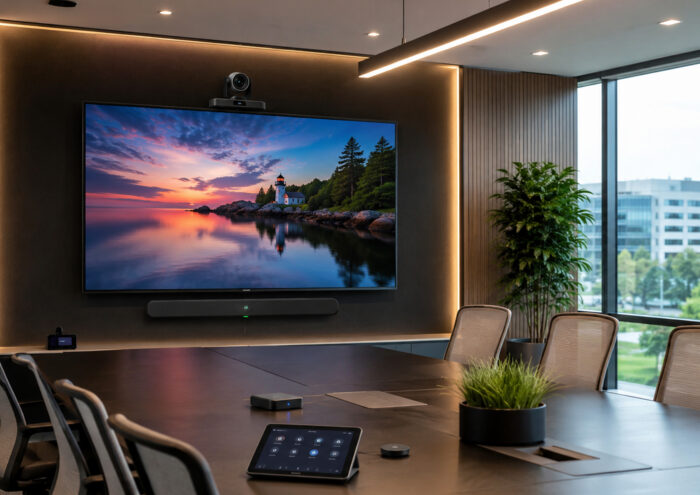
A modern AV environment can include:
- High-definition video conferencing cameras
- Professional microphones and speakers
- Wireless presentation tools
- Interactive displays
- Digital whiteboards
- Room scheduling panels
- Touchscreen control systems
- Digital signage
- Video walls for operations or executive spaces
For example, a government contractor near Bethesda may need secure conference rooms for hybrid project meetings. Similarly, a healthcare office in Baltimore may use AV technology for staff training and administrative coordination. In addition, a financial office in Rockville may depend on video conferencing to connect clients, advisors, and leadership teams.
When the technology works smoothly, every meeting feels more professional and productive.
Strong IT Infrastructure Makes AV Reliable
Effective AV systems depend on strong IT Infrastructure. Video conferencing platforms, displays, room controls, cameras, microphones, speakers, and cloud collaboration tools all rely on stable network performance.
If the network is outdated or poorly configured, even premium AV equipment can underperform. Video may freeze, audio may lag, and screen sharing may disconnect. Therefore, AV planning should always be part of a larger IT Infrastructure strategy.
A reliable infrastructure foundation supports:
- Strong bandwidth for video and audio
- Secure access for users and devices
- Stable network switching and routing
- Cloud platform compatibility
- Centralized system management
- Scalable support for future Technologies
Because of this, Maryland offices should treat AV as part of the full technology ecosystem rather than a separate room upgrade.
Structured Cabling Supports Better AV Performance
Although many AV tools include wireless features, Structured Cabling remains essential. Cabling connects displays, speakers, microphones, cameras, access points, control systems, network switches, and equipment racks.
Poor cabling can create signal problems, messy installations, troubleshooting delays, and limited upgrade options. In contrast, professional Structured Cabling gives AV systems a clean, organized, and scalable foundation.
Benefits of Structured Cabling for Office AV
A well-designed cabling system helps Maryland businesses improve:
- Audio and video signal quality
- Network reliability
- Equipment organization
- Troubleshooting speed
- Room flexibility
- Future upgrade planning
- Integration with IP Security and Data Centers
Additionally, cabling is especially important during office renovations, conference room upgrades, new construction, and multi-room AV deployments. With the right foundation, businesses can avoid costly rework and support long-term growth.
Radio Frequency Improves Wireless Collaboration
Many office AV systems rely on Radio Frequency technologies. Wireless microphones, Wi-Fi-enabled displays, Bluetooth devices, mobile controls, and presentation systems all depend on clean RF performance.
However, Maryland offices can face wireless challenges. Dense buildings, older construction, multiple floors, neighboring networks, and high device usage may all affect signal quality. Without proper planning, teams may experience dropped connections, lagging presentations, or unreliable wireless sharing.
With professional Radio Frequency design, businesses can reduce interference and improve wireless performance. Consequently, employees can collaborate more smoothly and maintain a stronger digital presence during meetings, presentations, and client conversations.
IP Security and AV Work Together
Modern IP Security systems often overlap with AV technology. Cameras, intercoms, access control systems, paging tools, emergency displays, video walls, and monitoring platforms can all support safer and more responsive office environments.
For instance, a corporate office in Annapolis may use digital signage for visitor communication while relying on access control for secure areas. Likewise, an education facility in College Park may use displays, intercoms, and cameras for announcements and emergency communication.
When IP Security and AV systems are planned together, businesses gain better visibility, faster communication, and stronger control over the workplace.
Managed Services Keep AV Systems Running Smoothly
Installing AV technology is only the beginning. Over time, systems need updates, monitoring, troubleshooting, user support, and lifecycle planning. That is where Managed Services provide long-term value.
Managed Services help Maryland offices keep AV systems ready for daily use by supporting:
- AV device monitoring
- Network troubleshooting
- Firmware and software updates
- User support
- Preventive maintenance
- Room performance reviews
- System documentation
- Upgrade planning
Instead of waiting for a conference room issue to interrupt an important meeting, businesses can take a proactive approach. As a result, teams spend less time troubleshooting and more time communicating effectively.
Data Centers Support Enterprise AV Environments
Data Centers and server rooms often support the backend systems that make AV technology work. Video conferencing platforms, content storage, cloud access, monitoring tools, security applications, and digital signage systems may all depend on centralized infrastructure.
For larger Maryland organizations, data center planning can improve AV performance across multiple rooms, departments, or office locations. A company in Frederick may need connected meeting rooms across several branches, while a Baltimore healthcare organization may require training spaces supported by secure network infrastructure.
In both cases, Data Centers help protect uptime, performance, and scalability.
Electricity/Utility Construction Creates a Reliable Foundation
AV systems also require proper power, grounding, conduit, pathways, mounting, and utility coordination. Electricity/Utility Construction helps ensure that displays, speakers, cameras, equipment racks, control panels, access points, and collaboration tools are installed safely and correctly.
Without proper planning, businesses may face overloaded circuits, poor device placement, exposed wiring, or expensive rework. However, when electrical and utility needs are coordinated with AV design, the final result is cleaner, safer, and more dependable.
This is especially important for Maryland offices undergoing renovations, expansions, new construction, or conference room modernization.
Why Maryland Organizations Choose Instrata
Instrata provides professional technology services for commercial, enterprise, industrial, and residential clients throughout Maryland, as well as Arizona, North Carolina, South Carolina, New Jersey, New York, Pennsylvania, and Virginia.
Organizations choose Instrata for:
- Audio Visual Services and Solutions
- Structured Cabling
- IP Security
- Radio Frequency planning
- IT Infrastructure upgrades
- Electricity/Utility Construction
- Managed Services
- Data Centers support
- Scalable Technologies for growing businesses
Whether supporting a conference room upgrade in Baltimore, an AV deployment near Bethesda, a digital signage project in Annapolis, or an IT Infrastructure improvement in Rockville, Instrata delivers fast, professional, and reliable technology solutions.
Make Maryland Offices More Connected with Instrata
Audio Visual Services and Solutions are becoming essential in Maryland offices because they improve meetings, support hybrid work, strengthen communication, and create more productive collaboration spaces. When supported by Structured Cabling, IP Security, Radio Frequency, Managed Services, Data Centers, Electricity/Utility Construction, and strong IT Infrastructure, AV systems become a reliable foundation for modern business success.
Contact us today to learn how structured cabling can transform your business operations