

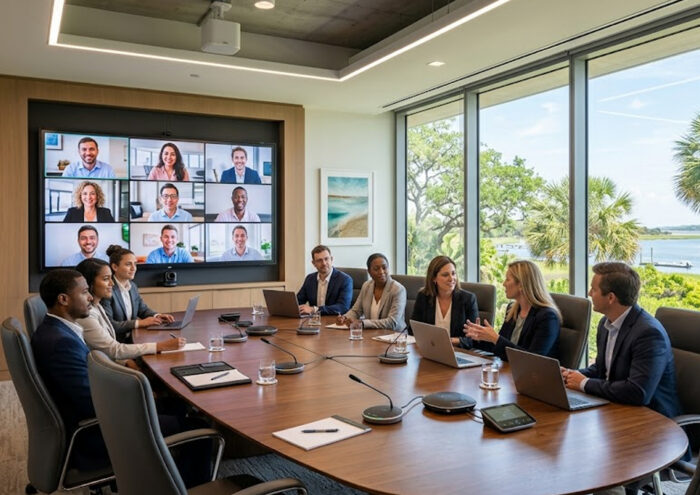
Meetings are where decisions are made, projects move forward, teams align, and clients form impressions. For businesses across South Carolina, from Charleston and Columbia to Greenville, Spartanburg, Myrtle Beach, Rock Hill, Florence, and surrounding communities, meeting quality directly affects productivity and communication.
However, effective meetings require more than a table, chairs, and a screen. Today’s teams depend on video conferencing, microphones, speakers, displays, wireless presentation tools, digital signage, and collaboration platforms. Because of this, professional Audio Visual Services and Solutions have become essential for modern meeting spaces.
When supported by reliable IT Infrastructure, professional Structured Cabling, secure IP Security, proactive Managed Services, scalable Data Centers, and modern Technologies, audio visual systems help South Carolina businesses host clearer, smoother, and more productive meetings.
Why Audio Visual Solutions Matter in Modern Meetings
Modern meetings often include both in-person and remote participants. Employees may join from conference rooms, home offices, job sites, client locations, or other company branches. As a result, meeting technology must support everyone equally.
Professional Audio Visual Services and Solutions may include:
- Video conferencing systems
- Conference room displays
- Speakers and microphones
- Wireless presentation tools
- Control panels
- Digital signage
- Interactive displays
- Training room systems
- Boardroom technology
- Hybrid meeting solutions
For example, a corporate office in Charleston may need executive conference rooms for client presentations. Meanwhile, a healthcare organization in Columbia may use AV systems for staff training and department meetings. Similarly, a manufacturer in Greenville may rely on meeting room displays and microphones to connect production teams with leadership.
In each case, strong AV technology helps people communicate clearly and make better use of meeting time.
Clear Audio Improves Participation
Poor audio is one of the most common meeting problems. If participants cannot hear clearly, they miss details, repeat questions, and lose focus. This is especially frustrating during hybrid meetings where remote team members depend entirely on room microphones and speakers.
Professional AV systems improve audio quality through:
- Proper microphone placement
- Ceiling or table microphones
- High-quality speakers
- Acoustic planning
- Echo reduction
- Balanced sound coverage
- Integration with conferencing platforms
As a result, everyone in the meeting can hear and contribute more easily. Additionally, clear audio helps reduce misunderstandings and keeps conversations moving.
For South Carolina businesses with busy teams, this can save valuable time during daily meetings, training sessions, and client calls.
Better Video Creates Stronger Engagement
Video quality matters because people communicate through expressions, gestures, and visual cues. Blurry cameras, poor angles, or unreliable video connections can make meetings feel disconnected.
Professional Audio Visual Services and Solutions can improve video by providing:
- High-quality conferencing cameras
- Proper camera placement
- Large displays
- Multi-screen setups
- Reliable video connections
- Better room visibility
- Integration with collaboration tools
For hybrid meetings, better video helps remote participants feel more connected to the room. Likewise, in-person teams can view remote speakers and shared content more clearly.
Consequently, meetings become more engaging, professional, and productive.
AV Systems Support Hybrid Work
Hybrid work is now common for many South Carolina businesses. Employees may split time between offices, homes, client sites, and field locations. Therefore, meeting rooms must support flexible collaboration.
A well-designed AV system helps hybrid teams by offering:
- Reliable video conferencing
- Easy screen sharing
- Clear microphones and speakers
- Large displays for shared content
- Wireless presentation tools
- Simple room controls
- Cloud platform integration
Without the right setup, hybrid meetings can become frustrating. Remote employees may struggle to hear side conversations, view presentations, or participate naturally. However, with professional AV planning, meetings feel more balanced and inclusive.
This helps businesses maintain strong communication even when teams are spread across multiple locations.
IT Infrastructure Keeps Meeting Technology Reliable
Audio visual systems depend heavily on strong IT Infrastructure. Video conferencing, wireless presentations, digital signage, control systems, and cloud collaboration tools all require stable networks and secure connectivity.
Reliable IT Infrastructure supports AV meetings by improving:
- Network performance
- Video call stability
- Wireless connectivity
- Cloud platform access
- Device management
- User permissions
- System monitoring
- Cybersecurity controls
For instance, a business in Columbia may need multiple meeting rooms connected to cloud conferencing platforms. At the same time, a logistics company in Spartanburg may need training rooms and operational displays connected to internal systems.
Moreover, IT and AV planning should happen together. When meeting technology is integrated with the larger network environment, businesses experience fewer disruptions and easier support.
Structured Cabling Creates the Meeting Room Foundation
Behind every reliable meeting room is professional Structured Cabling. Displays, cameras, microphones, speakers, control panels, access points, and digital signage all need dependable connectivity.
Poor cabling can cause:
- Dropped video calls
- Audio delays
- Display problems
- Unstable conferencing systems
- Messy equipment areas
- Difficult troubleshooting
- Limited upgrade options
Professional Structured Cabling supports AV performance by creating organized, tested, and scalable pathways for connected systems.
Additionally, clean cabling makes maintenance easier for IT teams and Managed Services providers. When cables are labeled and properly installed, problems can be resolved faster and meeting spaces can stay available with fewer interruptions.
Managed Services Help Prevent Meeting Disruptions
Even the best AV systems need ongoing support. Software updates, network changes, platform integrations, device settings, and user questions can all affect meeting quality.
That is why Managed Services are valuable for businesses that depend on meeting technology.
Managed Services can help with:
- Conference room support
- Device monitoring
- Software updates
- Network troubleshooting
- User assistance
- Collaboration platform support
- Equipment lifecycle planning
- Vendor coordination
- Documentation
- Security reviews
For busy IT managers and facility teams, managed support reduces the burden of maintaining every room internally. Furthermore, proactive service helps prevent small issues from disrupting important meetings, presentations, or training sessions.
This creates stronger workplace synergy by making collaboration tools easier to use and manage.
IP Security and AV Systems Can Work Together
Modern meeting spaces often overlap with IP Security and facility communication systems. Intercoms, access control displays, monitoring rooms, emergency messaging, and visitor communication tools may all depend on AV technology.
AV and IP Security systems may work together through:
- Reception area intercoms
- Visitor communication displays
- Security monitoring screens
- Emergency notification systems
- Access control interfaces
- Facility-wide announcements
- Video walls
For South Carolina businesses with larger offices, campuses, warehouses, or data centers, this integration can improve both communication and safety. As a result, teams gain better awareness during daily operations and urgent situations.
Data Centers Support Meeting Platforms
Many AV systems rely on applications, storage, cloud platforms, and network resources supported by Data Centers or server environments. Video conferencing systems, digital signage platforms, collaboration tools, and monitoring software all need dependable backend infrastructure.
Data Centers can support meeting technology through:
- Application availability
- Secure storage
- Network connectivity
- Backup systems
- Cloud access
- System monitoring
- Business continuity
For South Carolina organizations with multiple offices or high communication demands, data center reliability helps ensure meeting tools remain available when teams need them most.
Radio Frequency Supports Wireless Meeting Tools
Many modern meeting rooms use wireless devices. Wireless microphones, presentation systems, tablets, laptops, room controls, and mobile devices all depend on strong wireless performance.
Because of this, Radio Frequency planning can improve meeting reliability by reducing:
- Wireless interference
- Signal dropouts
- Poor device pairing
- Audio interruptions
- Weak coverage
- Delayed screen sharing
- Connection instability
This is especially important in conference centers, large offices, schools, healthcare facilities, and enterprise spaces where many wireless devices may operate at once.
Electricity and Utility Construction Considerations
Audio visual systems also require proper power, mounting locations, conduit, pathways, grounding, and equipment space. Therefore, Electricity/Utility Construction should be considered early in meeting room planning.
This is especially important for:
- New construction projects
- Office renovations
- Conference room buildouts
- Training rooms
- Auditoriums
- Digital signage deployments
- Large commercial spaces
By coordinating AV systems with power and utility needs early, businesses can avoid delays, reduce rework, and improve final system performance.
Why South Carolina Businesses Choose Instrata
Instrata helps South Carolina businesses design, deploy, and support reliable meeting and communication technology. From Charleston and Columbia to Greenville, Spartanburg, Myrtle Beach, Rock Hill, Florence, and surrounding communities, Instrata supports commercial, enterprise, industrial, and residential clients with scalable technology solutions.
Instrata specializes in:
- Structured Cabling
- IP Security
- Radio Frequency
- IT Infrastructure
- Electricity/Utility Construction
- Technologies
- Managed Services
- Data Centers
- Audio Visual Services and Solutions
By bringing these services together, Instrata helps organizations avoid the complexity of working with disconnected vendors. Instead, businesses can rely on one experienced partner for AV systems, cabling, infrastructure, security, managed IT, data centers, RF planning, and utility coordination.
Additionally, Instrata serves clients across Arizona, North Carolina, New Jersey, New York, Pennsylvania, Maryland, and Virginia, making it a strong choice for regional and multi-location organizations.
Make Meetings More Productive with Instrata
Audio Visual Services and Solutions are important for meetings because they improve audio, video, collaboration, hybrid work, information sharing, and communication reliability. When supported by strong IT Infrastructure, Structured Cabling, IP Security, Managed Services, Data Centers, Radio Frequency, Electricity/Utility Construction, and modern Technologies, AV systems become essential to everyday business success.
For South Carolina businesses that want clearer meetings, stronger collaboration, and more dependable workplace technology, Instrata provides the experience and professionalism needed to build scalable AV environments.