

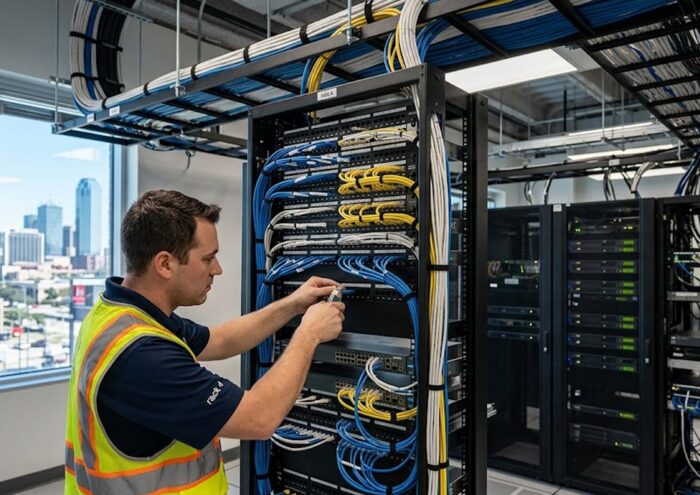
Texas is one of the fastest-growing business environments in the country. From technology firms in Austin to energy companies in Houston, healthcare systems in Dallas, and logistics hubs in San Antonio, organizations across the state are expanding rapidly.
Before investing in network cabling, however, it’s critical to understand that this isn’t just a wiring project — it’s the foundation of your entire IT Infrastructure.
Whether you’re building a new facility, upgrading existing systems, or expanding operations, here’s what every Texas business should know before making a network cabling investment.
Network Cabling Is the Backbone of Your Technology Infrastructure
Modern organizations rely on interconnected systems, including:
- Structured Cabling systems
- IP Security networks
- Data Centers and server rooms
- Radio Frequency (RF) systems
- Cloud connectivity
- Audio Visual Services and Solutions
- Managed Services platforms
- Smart building technologies
Your network cabling directly impacts speed, reliability, scalability, and security. Poor planning can result in bottlenecks, downtime, and expensive retrofits.
A properly designed Structured Cabling system supports long-term growth and seamless integration of future technologies.
Texas Businesses Must Plan for Scalability
Texas markets are booming. Commercial real estate developments, industrial parks, and enterprise campuses are expanding across Austin, Dallas–Fort Worth, Houston, San Antonio, and El Paso.
When investing in network cabling, you must think beyond today’s needs.
Key Questions to Ask
- Will this infrastructure support 5–10 years of growth?
- Is there enough bandwidth for cloud applications and Data Centers?
- Can it handle expanding IP Security camera systems?
- Does it support future Radio Frequency deployments?
- Is there room for additional Audio Visual integrations?
Designing for scalability now prevents costly rewiring later.
Understand the Difference Between Structured Cabling and Basic Wiring
One of the most common mistakes businesses make is confusing low-voltage wiring with a comprehensive Structured Cabling solution.
Basic Wiring
- Installed as needed
- Limited documentation
- No long-term scalability strategy
- Often inconsistent performance
Professional Structured Cabling
- Engineered layout and pathway planning
- Clearly labeled and documented infrastructure
- Certified installation and testing
- Designed to integrate with IT Infrastructure, IP Security, and Data Centers
- Built to industry standards
Structured Cabling provides organization, reliability, and future-proofing — all critical for Texas businesses operating in competitive industries.
Climate and Environmental Factors in Texas Matter
Texas presents unique environmental challenges that directly affect network cabling installations:
- Extreme summer heat
- Humidity, especially in Gulf Coast areas
- Dust and industrial exposure
- Storms and flooding risks
- Large warehouse environments
Improper cable selection or poor installation techniques can lead to premature degradation and performance issues.
Best practices include using plenum-rated or outdoor-rated cabling where required, installing proper conduit and pathway protection, ensuring secure mounting in high-temperature ceilings, and planning around Electricity/Utility Construction requirements.
Environmental planning protects your investment and ensures consistent performance.
Integration with IP Security and Data Centers Is Critical
Network cabling doesn’t operate in isolation.
Your infrastructure must support high-resolution IP Security cameras, access control systems, Data Center interconnects, cloud backups, Managed Services monitoring, and Radio Frequency signal distribution.
For example, a warehouse in Dallas deploying AI-powered security cameras needs sufficient bandwidth and properly terminated cabling to prevent lag or video loss. A Houston medical facility requires secure, redundant connections to maintain uptime and protect sensitive data.
Investing in a unified IT Infrastructure strategy ensures your network cabling enhances operational efficiency rather than limiting it.
Don’t Overlook Power and Utility Coordination
Electricity and network infrastructure go hand in hand.
In Texas commercial and industrial builds, Electricity/Utility Construction planning must align with cabling installations to avoid interference issues, overcrowded pathways, safety violations, inspection delays, and costly rework.
Proper coordination between electrical contractors and low-voltage specialists ensures clean separation of power and data systems while maintaining code compliance. This is especially important in large-scale facilities such as manufacturing plants, hospitals, and enterprise campuses.
Certification, Testing, and Documentation Are Non-Negotiable
A professional network cabling investment includes certified cable testing, detailed labeling, as-built drawings, warranty-backed installations, and compliance with ANSI/TIA standards.
Without proper documentation, future troubleshooting becomes time-consuming and expensive. For organizations utilizing Managed Services, documentation allows IT teams to quickly diagnose issues, plan upgrades, and maintain performance.
Think of documentation as insurance for your IT Infrastructure.
Budgeting: Look Beyond the Initial Price Tag
Cost matters — but the cheapest bid often becomes the most expensive mistake.
Low-cost installations frequently result in signal degradation, poor terminations, compliance failures, downtime, and premature system replacement.
When evaluating proposals, consider:
- Experience with Texas commercial and enterprise projects
- Integration expertise across IP Security, Data Centers, and Audio Visual Services and Solutions
- Knowledge of local building codes
- Scalability planning
- Warranty coverage
Your network cabling is a long-term asset. Invest accordingly.
Managed Services Add Long-Term Value
After installation, ongoing support is essential.
Managed Services can monitor network performance, detect potential issues before failure, support system expansions, maintain security standards, and reduce IT team workload.
For fast-growing Texas businesses, Managed Services help maintain operational continuity while allowing internal teams to focus on strategic initiatives.
Why Texas Businesses Are Prioritizing Professional Network Cabling
Across Texas, organizations are modernizing infrastructure to support hybrid work environments, cloud-based applications, smart building automation, advanced IP Security systems, enterprise Data Centers, Radio Frequency coverage in large facilities, and integrated Audio Visual Services and Solutions.
Network cabling is the foundation that makes all of this possible. Without a strong foundation, even the most advanced technologies will underperform.
Make a Strategic Investment — Not Just a Wiring Purchase
Investing in network cabling in Texas requires careful planning, environmental awareness, integration expertise, and a long-term scalability strategy.
When done correctly, Structured Cabling enhances business continuity, operational efficiency, security, scalability, performance, and return on technology investments. When done poorly, it creates limitations that can slow your growth.
Ready to Build a Future-Ready Network Infrastructure in Texas?
If your organization is planning a new build, expansion, or infrastructure upgrade, now is the time to make a smart investment.
Schedule a consultation today to discuss your Structured Cabling, IT Infrastructure, IP Security, Radio Frequency, Electricity/Utility Construction, Data Centers, Audio Visual Services and Solutions, and Managed Services needs.