

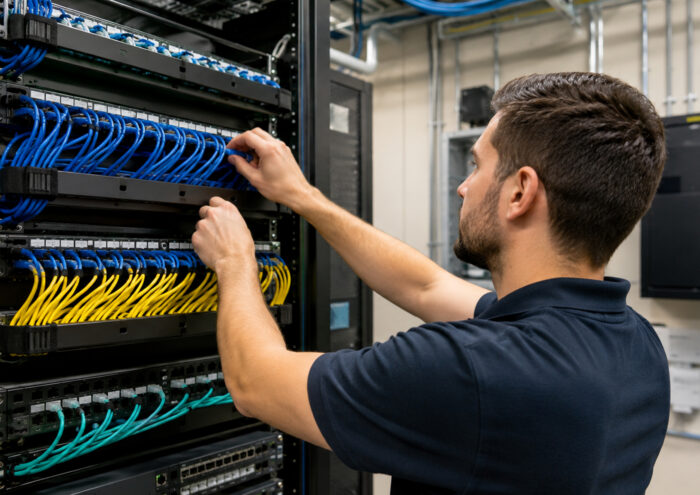
A reliable network starts behind the walls, above the ceilings, inside the equipment rooms, and at every connection point your business depends on. For Arizona companies in Phoenix, Scottsdale, Tucson, Mesa, Tempe, Chandler, Glendale, and surrounding communities, professional Structured Cabling is the foundation for fast, secure, and scalable technology.
Whether you are opening a new office, upgrading a warehouse, expanding a data center, or modernizing your IT Infrastructure, choosing the right cabling installation matters. Poor cabling can cause slow speeds, dropped connections, unreliable Wi-Fi, security camera issues, and expensive troubleshooting. However, a properly designed cabling system can support long-term growth, stronger performance, and smoother daily operations.
Why Structured Cabling Matters for Arizona Businesses
Modern businesses rely on connected systems every day. Computers, phones, wireless access points, cloud platforms, IP Security cameras, access control systems, conference rooms, servers, and connected devices all depend on dependable cabling.
As a result, Structured Cabling should not be treated as a basic wiring job. Instead, it should be viewed as a long-term infrastructure investment.
For example, a professional office in Scottsdale may need cabling for workstations, conference rooms, and cloud access. Meanwhile, a warehouse in Mesa may need network drops for scanners, wireless access points, inventory systems, and security cameras. Similarly, a data-driven company in Phoenix may need fiber and copper cabling to support high-performance Data Centers.
In each case, professional cabling helps keep technology reliable.
Look for Experience with Commercial and Enterprise Projects
Before hiring a structured cabling installer in Arizona, look for a provider with experience in commercial, enterprise, industrial, and data center environments. Residential cabling and business-grade infrastructure are very different.
A qualified provider should understand:
- Office buildouts
- Warehouse cabling
- Fiber optic installations
- Cat6 and Cat6A cabling
- Data center cabling
- Network closet organization
- Wireless access point cabling
- IP Security cabling
- Multi-location rollouts
- Testing and certification
Additionally, the installer should understand how cabling connects to your larger technology environment. Structured Cabling supports Technologies such as cloud systems, VoIP phones, video conferencing, surveillance, access control, and managed IT platforms.
When a provider understands the full picture, your cabling system is more likely to support both current operations and future upgrades.
Make Sure the Cabling Design Supports Scalability
Your business may not need every connection today, but your network should be ready for tomorrow. Therefore, scalability is one of the most important factors to consider in any Structured Cabling installation.
A scalable cabling design can support:
- Additional employees
- More workstations
- New wireless access points
- Expanded IP Security systems
- Larger conference rooms
- Additional servers
- Cloud-connected applications
- Future bandwidth needs
- Office expansions
- New technology deployments
For Arizona businesses experiencing growth, this flexibility is essential. A company in Chandler may add new departments. A warehouse in Tucson may expand its scanning and inventory systems. A corporate office in Tempe may need more collaboration spaces and connected meeting rooms.
With proper planning, Structured Cabling gives your business the framework to grow without constantly rebuilding the network.
Ask About Testing and Certification
A professional cabling installation should always include testing and certification. Without testing, it is difficult to know whether the cabling will perform as expected.
Testing helps verify:
- Cable performance
- Signal quality
- Proper terminations
- Network speed capability
- Fiber optic performance
- Connection reliability
- Installation accuracy
Moreover, certification provides documentation that your cabling meets performance standards. This is especially important for businesses that depend on high-speed data transfer, secure systems, cloud platforms, or mission-critical applications.
If an installer does not offer testing and documentation, that is a warning sign.
Prioritize Clean Cable Management
Clean cabling is more than an appearance issue. It directly affects maintenance, troubleshooting, airflow, safety, and future expansion.
A professional Structured Cabling installation should include:
- Organized patch panels
- Labeled cables
- Proper cable pathways
- Clean network racks
- Secure cable supports
- Neat equipment rooms
- Clear documentation
Messy cabling can make even simple troubleshooting difficult. In contrast, organized cabling helps IT teams and Managed Services providers identify issues faster, add devices more efficiently, and reduce downtime.
For busy Arizona IT managers and facility teams, clean cable management saves time and prevents frustration.
Consider Fiber Optic Cabling for High-Performance Needs
Not every business needs fiber everywhere. However, many Arizona companies benefit from fiber optic cabling in key parts of their network.
Fiber can support:
- High-speed backbone connections
- Long-distance network runs
- Data center environments
- Multi-building campuses
- High-bandwidth applications
- Future network upgrades
- Stronger performance for growing systems
For businesses with large facilities, heavy data usage, cloud platforms, or Data Centers, fiber optic cabling may be a smart investment. Additionally, fiber can help prepare your infrastructure for future technology demands.
A qualified provider should explain where fiber makes sense and where copper cabling is sufficient.
Ensure Support for IP Security Systems
Modern IP Security systems depend on reliable cabling. Cameras, access control systems, intercoms, and video management platforms need strong network connections to function properly.
Structured Cabling supports IP Security by providing:
- Dedicated camera connections
- Power over Ethernet support
- Reliable access control wiring
- Organized security pathways
- Scalable capacity for future devices
- Easier troubleshooting
- Better system performance
For Arizona offices, warehouses, schools, healthcare facilities, commercial properties, and industrial sites, IP Security is essential for protecting people, property, and equipment. Consequently, cabling should be planned with security coverage in mind from the beginning.
Look for Knowledge of IT Infrastructure
Structured Cabling is only one part of your technology environment. Therefore, your provider should also understand IT Infrastructure.
This includes:
- Switches
- Routers
- Firewalls
- Wireless access points
- Servers
- Network closets
- Cloud connectivity
- Backup systems
- Endpoint devices
When cabling is designed around the full infrastructure, businesses get better performance and fewer compatibility issues. For example, wireless access points need proper placement and reliable cabling to provide strong coverage. Similarly, network closets need organized cabling, adequate space, and proper equipment layouts.
A cabling provider with IT Infrastructure experience can help your business avoid common planning mistakes.
Plan for Radio Frequency and Wireless Performance
Even wireless systems depend on physical cabling. Access points require reliable connections back to the network. In larger Arizona facilities, Radio Frequency planning may also be needed to improve wireless coverage and reduce interference.
Radio Frequency planning is especially useful for:
- Warehouses
- Distribution centers
- Manufacturing facilities
- Large offices
- Campuses
- Healthcare facilities
- Industrial environments
When RF planning and Structured Cabling work together, businesses get stronger wireless performance. As a result, mobile devices, scanners, tablets, laptops, and cloud-connected tools can operate more reliably.
Include Audio Visual Services and Solutions
Modern offices need more than basic network connections. Conference rooms, training spaces, digital signage, video conferencing systems, and presentation technology all depend on reliable cabling.
Professional Audio Visual Services and Solutions may require cabling for:
- Displays
- Cameras
- Microphones
- Speakers
- Control systems
- Wireless presentation tools
- Digital signage
- Hybrid meeting platforms
For Arizona businesses with hybrid teams, client presentations, or training rooms, AV planning should be included during the cabling design stage. This helps avoid costly retrofits later.
Do Not Overlook Electricity and Utility Construction
Technology systems require proper power, pathways, conduit, grounding, and site coordination. Because of this, Electricity/Utility Construction can play an important role in structured cabling projects.
This is especially important for:
- New construction
- Office renovations
- Outdoor security systems
- Data center upgrades
- Network closet expansions
- Industrial facilities
- Multi-building campuses
By coordinating cabling with power and utility needs early, businesses can reduce delays, avoid rework, and create a stronger infrastructure foundation.
Why Arizona Businesses Choose Instrata
Instrata helps Arizona businesses design, install, and support reliable Structured Cabling and technology systems. From Phoenix and Scottsdale to Tucson, Mesa, Tempe, Chandler, Glendale, and surrounding communities, Instrata supports commercial, enterprise, industrial, and residential clients with scalable technology solutions.
Instrata specializes in:
- Structured Cabling
- IP Security
- Radio Frequency
- IT Infrastructure
- Electricity/Utility Construction
- Technologies
- Managed Services
- Data Centers
- Audio Visual Services and Solutions
Additionally, Instrata serves clients across North Carolina, South Carolina, New Jersey, New York, Pennsylvania, Maryland, and Virginia, making it a strong choice for regional and multi-location organizations.
Build a Stronger Network with Instrata
The right Structured Cabling installation should be organized, tested, scalable, and designed around your business goals. It should support IT Infrastructure, IP Security, Radio Frequency, Managed Services, Data Centers, Audio Visual Services and Solutions, Electricity/Utility Construction, and future Technologies.
For Arizona businesses that need reliable network performance and room to grow, professional cabling is a smart investment.