

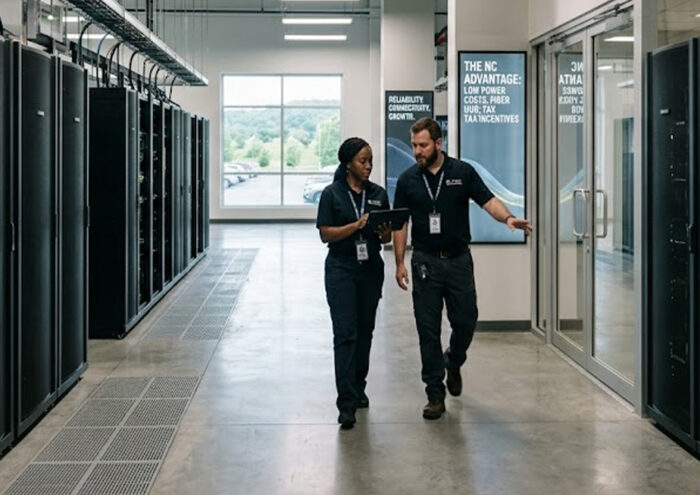
Data center infrastructure is one of the most important foundations for modern business performance. Whether your organization operates in Charlotte, Raleigh, Durham, Greensboro, Winston-Salem, Wilmington, Cary, Asheville, or another North Carolina market, your ability to store data, access applications, protect systems, and maintain uptime depends on reliable infrastructure.
For businesses that rely on cloud platforms, customer data, internal applications, cybersecurity tools, IP Security, and connected operations, Data Centers are more than equipment rooms. They are mission-critical environments that support productivity, business continuity, and long-term growth.
When designed correctly, data center infrastructure brings together IT Infrastructure, Structured Cabling, power planning, cooling, security, Managed Services, and modern Technologies to create a stable foundation for daily operations.
What Is Data Center Infrastructure?
Data center infrastructure includes the physical and digital systems that support servers, storage, applications, cloud connectivity, backup systems, and business networks. It may exist inside an on-premise server room, a dedicated data center, a cloud-connected environment, or a hybrid setup.
Core data center infrastructure may include:
- Servers and storage systems
- Network switches and routers
- Firewalls and cybersecurity tools
- Backup and disaster recovery platforms
- Power and cooling systems
- Structured cabling
- IP Security and access control
- Monitoring tools
- Racks, cabinets, and patch panels
- Cloud and hybrid connectivity
Together, these components help businesses keep critical systems available, secure, and scalable.
Why Data Center Infrastructure Matters for North Carolina Businesses
North Carolina businesses operate in many different industries, including healthcare, finance, logistics, education, manufacturing, legal services, technology, and professional services. Although each industry has different needs, they all depend on reliable data access and secure systems.
For example, a healthcare provider in Durham may need dependable access to patient records. Meanwhile, a logistics company in Greensboro may depend on warehouse systems, inventory platforms, and mobile devices. Similarly, a corporate office in Charlotte may need secure cloud connectivity for hybrid employees.
Without strong data center infrastructure, businesses may face:
- Downtime
- Slow application performance
- Data loss
- Security vulnerabilities
- Poor backup reliability
- Network bottlenecks
- Limited scalability
- Difficult troubleshooting
- Higher long-term IT costs
As a result, data center infrastructure should be planned carefully rather than treated as an afterthought.
Strong IT Infrastructure Is the Backbone
Reliable IT Infrastructure is the backbone of every data center environment. Servers, switches, routers, firewalls, storage systems, cloud platforms, and backup tools all need to work together efficiently.
Strong IT Infrastructure supports:
- Faster application performance
- Stable network connectivity
- Secure remote access
- Better system monitoring
- Reliable data storage
- Easier troubleshooting
- Stronger cybersecurity
- Future expansion
Moreover, infrastructure should be designed around your business goals. A small office may need a secure server room and cloud backup, while a large enterprise may need redundant systems, high-speed connectivity, and advanced monitoring across multiple locations.
Structured Cabling Supports Performance and Scalability
Professional Structured Cabling is essential for dependable data center infrastructure. Even the best servers and network equipment can underperform if cabling is disorganized, outdated, or poorly installed.
Structured Cabling supports data centers through:
- Fiber optic backbone connections
- Copper network cabling
- Rack-to-rack connectivity
- Organized patch panels
- Clean cable pathways
- Better airflow
- Easier maintenance
- Scalable expansion
Additionally, clean cabling makes it easier for IT teams and Managed Services providers to identify issues, add equipment, and perform upgrades with less disruption.
For North Carolina businesses planning growth, structured cabling creates the physical foundation needed to support future users, applications, devices, and locations.
Data Centers Improve Business Continuity
Business continuity depends on keeping systems available during unexpected events. Network outages, hardware failures, cyber incidents, power issues, and natural disruptions can all affect operations.
Data Centers help support continuity through:
- Backup systems
- Disaster recovery planning
- Redundant network paths
- Secure storage
- Server monitoring
- Failover planning
- Proactive maintenance
For organizations in Raleigh, Charlotte, Durham, and beyond, downtime can affect customer service, compliance, productivity, and revenue. Therefore, a well-planned data center environment helps reduce risk and improve recovery when problems occur.
A strong infrastructure plan also gives companies better operational durability as technology demands increase.
IP Security Protects Critical Systems
IP Security is a key part of data center infrastructure. Server rooms, network closets, storage systems, and equipment areas should be protected from unauthorized access, tampering, and physical threats.
IP Security may include:
- Network-connected cameras
- Access control systems
- Video monitoring
- Door entry management
- Visitor tracking
- Motion alerts
- Remote monitoring
- Security logs
For North Carolina businesses that handle sensitive data, financial records, healthcare information, or mission-critical applications, physical security is just as important as cybersecurity.
When IP Security is integrated with IT Infrastructure, businesses gain better visibility and stronger protection around critical technology assets.
Managed Services Help Maintain Reliability
Data center infrastructure requires ongoing attention. Servers need updates, backups must be checked, security settings should be reviewed, and systems need monitoring.
That is why Managed Services are valuable for data center environments.
Managed Services can help with:
- Server monitoring
- Network support
- Backup verification
- Cybersecurity management
- Patch updates
- Hardware lifecycle planning
- Disaster recovery planning
- Performance reporting
- Vendor coordination
For busy IT managers and business leaders, managed support reduces the pressure of maintaining every system internally. Furthermore, proactive service helps identify small issues before they become major disruptions.
Cloud and Hybrid Technologies Depend on Data Center Planning
Many North Carolina businesses now use a mix of on-premise systems, private cloud platforms, public cloud services, and remote access tools. These hybrid Technologies require careful planning.
Data center infrastructure can support:
- Cloud application access
- Secure file storage
- Virtual servers
- Remote employees
- Backup platforms
- Collaboration tools
- Business applications
- Data synchronization
However, cloud performance still depends on local networks, firewalls, cabling, security, and connectivity. Therefore, businesses should consider both cloud strategy and physical infrastructure when planning technology upgrades.
Radio Frequency Supports Connected Operations
Although data centers rely heavily on wired infrastructure, Radio Frequency can support broader business connectivity. Warehouses, healthcare facilities, campuses, manufacturing sites, and large offices often depend on wireless devices, scanners, tablets, sensors, and mobile workstations.
Radio Frequency planning can support:
- Wireless coverage
- Mobile workflows
- Inventory systems
- Facility monitoring
- Wireless security tools
- Campus communication
- Industrial connectivity
When RF planning is aligned with data center infrastructure, businesses gain more reliable access to applications, storage, and operational systems across the facility.
Audio Visual Services and Solutions Rely on Infrastructure
Modern Audio Visual Services and Solutions also depend on strong data center and network infrastructure. Video conferencing, digital signage, training rooms, security displays, and collaboration platforms all need reliable connectivity.
Data center infrastructure can support AV systems by improving:
- Video conferencing stability
- Digital signage management
- Cloud platform access
- Secure storage
- Network performance
- System monitoring
- Business continuity
For North Carolina offices, schools, healthcare facilities, and enterprise spaces, dependable AV systems help teams communicate clearly and work more efficiently.
Electricity and Utility Construction Should Be Planned Early
Data center infrastructure also depends on proper power, grounding, conduit, cooling coordination, pathways, equipment space, and utility planning. Because of this, Electricity/Utility Construction should be considered early in any data center project.
This is especially important for:
- New construction
- Server room upgrades
- Backup power planning
- Network closet expansions
- Outdoor technology deployments
- Industrial facilities
- Multi-building campuses
By coordinating electrical and utility needs early, businesses can reduce delays, avoid rework, and build infrastructure that supports long-term reliability.
Why North Carolina Businesses Choose Instrata
Instrata helps North Carolina businesses design, deploy, and support reliable data center and technology infrastructure. From Charlotte and Raleigh to Durham, Greensboro, Winston-Salem, Wilmington, Cary, Asheville, and surrounding communities, Instrata supports commercial, enterprise, industrial, and residential clients with scalable technology solutions.
Instrata specializes in:
- Structured Cabling
- IP Security
- Radio Frequency
- IT Infrastructure
- Electricity/Utility Construction
- Technologies
- Managed Services
- Data Centers
- Audio Visual Services and Solutions
By bringing these services together, Instrata helps organizations avoid the complexity of working with disconnected vendors. Instead, businesses can rely on one experienced partner for data centers, cabling, infrastructure, security, managed IT, RF planning, AV systems, and utility coordination.
Additionally, Instrata serves clients across Arizona, South Carolina, New Jersey, New York, Pennsylvania, Maryland, and Virginia, making it a strong choice for regional and multi-location organizations.
Build Better Data Center Infrastructure with Instrata
Data center infrastructure is essential for North Carolina businesses that depend on uptime, secure data access, reliable applications, cloud connectivity, and scalable technology. When supported by professional Structured Cabling, strong IT Infrastructure, IP Security, Managed Services, Radio Frequency planning, Electricity/Utility Construction, Technologies, and Audio Visual Services and Solutions, data centers become a powerful foundation for business success.