

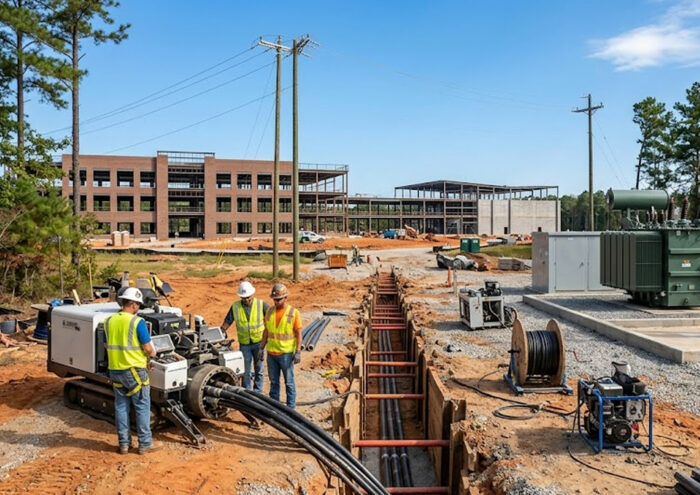
South Carolina’s commercial growth continues to accelerate. From retail developments in Charleston and hospitality projects along the coast to manufacturing facilities in Greenville and office expansions in Columbia, businesses across the state require reliable and scalable power systems to operate efficiently.
At the heart of these projects is professional Electricity/Utility Construction. Commercial power systems must do more than simply deliver electricity—they must support advanced IT Infrastructure, high-performance Data Centers, secure IP Security systems, Radio Frequency networks, and integrated Audio Visual Services and Solutions.
For commercial property owners, developers, and enterprise leaders in South Carolina, strategic utility construction is essential for safety, performance, and long-term operational success.
The Importance of Commercial Power Infrastructure
Commercial facilities have far more complex electrical demands than residential properties. Office buildings, healthcare facilities, distribution centers, and mixed-use developments require:
- High-capacity electrical distribution
- Reliable service continuity
- Code-compliant installations
- Scalable infrastructure for growth
- Integrated technology support
In fast-growing cities like Charleston, Columbia, and Greenville, properly engineered utility systems ensure that commercial projects meet both current and future energy demands.
Core Components of Utility Construction for Commercial Systems
1. Power Distribution and Service Installation
Every commercial facility begins with a properly designed power distribution system. This includes:
- Main service panels
- Transformers and switchgear
- Underground and overhead utility feeds
- Metering systems
- Load balancing equipment
Accurate load calculations and system design prevent overloads and allow for expansion as the business grows.
2. Redundancy and Backup Systems
For many South Carolina businesses, downtime is not an option. Hospitals, data-driven enterprises, and industrial facilities require redundant systems such as:
- Backup generators
- Automatic transfer switches
- Uninterruptible Power Supply (UPS) systems
- Dual power feeds
These systems ensure operational continuity during storms, grid disruptions, or maintenance events.
3. Underground Utility Infrastructure
Modern commercial developments often utilize underground utility construction for improved safety and aesthetics. This involves:
- Trenching and conduit installation
- Coordination with telecommunications lines
- Protection against environmental damage
- Compliance with local and state regulations
Underground installations provide enhanced protection from severe weather, which is particularly important in coastal regions of South Carolina.
Supporting IT Infrastructure in Commercial Facilities
Today’s commercial buildings are powered by technology. From cloud-based operations to digital payment systems, a stable IT Infrastructure depends on reliable electrical support.
Utility construction for IT environments includes:
- Dedicated circuits for networking equipment
- Surge protection systems
- Grounding and bonding
- Environmental controls for server rooms
Without properly designed electrical systems, businesses risk network instability, equipment damage, and costly downtime.
Enabling High-Performance Data Centers
Many commercial enterprises operate on-site server rooms or full-scale Data Centers. These facilities require precise coordination between electrical infrastructure and cooling systems.
Professional utility construction ensures:
- High-capacity power feeds
- Redundant electrical pathways
- Energy-efficient power distribution
- Integration with monitoring systems
In South Carolina’s growing technology and logistics sectors, Data Center reliability directly impacts business performance.
Strengthening IP Security Systems
Modern IP Security systems depend on consistent electrical supply for surveillance cameras, access control systems, and monitoring platforms.
Utility construction enhances security by providing:
- Dedicated circuits for security equipment
- Backup power integration
- Surge protection for sensitive electronics
- Coordination with centralized control rooms
For commercial properties, reliable power ensures that surveillance and access control systems remain active at all times.
Supporting Radio Frequency and Wireless Connectivity
Wireless connectivity powered by Radio Frequency (RF) systems is essential in modern commercial environments. Retail spaces, warehouses, and office campuses rely on wireless networks for daily operations.
Electricity/Utility Construction supports RF systems by ensuring:
- Stable power for wireless access points
- Proper grounding for RF equipment
- Environmental controls for equipment rooms
Reliable electrical infrastructure enhances wireless network performance and minimizes disruptions.
Coordinating with Structured Cabling and AV Systems
Effective Structured Cabling installations require careful coordination with electrical systems to prevent interference and ensure efficiency.
Commercial projects benefit from:
- Organized equipment rooms
- Clearly defined pathways for power and data
- Reduced electromagnetic interference
- Scalable layouts for future expansion
Additionally, integrated Audio Visual Services and Solutions—such as conference room systems, digital signage, and presentation tools—depend on properly planned electrical infrastructure for optimal performance.
Energy Efficiency and Sustainability
Energy costs are a significant concern for commercial property owners. Modern utility construction integrates energy-efficient solutions such as:
- High-efficiency transformers
- LED lighting systems
- Smart power monitoring
- Load management technology
- Renewable energy integration options
In environmentally conscious markets across South Carolina, energy-efficient design reduces operational costs while supporting sustainability goals.
The Role of Managed Services
Once commercial power systems are installed, ongoing monitoring and maintenance are essential. Proactive Managed Services help businesses:
- Monitor energy usage
- Identify potential system failures
- Optimize load distribution
- Plan for capacity expansion
- Maintain compliance with safety standards
Managed Services ensure long-term reliability and reduce the risk of unexpected disruptions.
Benefits of Professional Utility Construction
Investing in professional Electricity/Utility Construction provides long-term advantages:
- Enhanced operational reliability
- Improved safety and regulatory compliance
- Reduced risk of downtime
- Scalable infrastructure for business growth
- Better integration with modern Technologies
For commercial developments throughout South Carolina, these benefits support both tenant satisfaction and business success.
Why South Carolina Businesses Trust Instrata
Across South Carolina—including Charleston, Columbia, Greenville, Spartanburg, Rock Hill, and Myrtle Beach—organizations rely on Instrata for comprehensive infrastructure solutions.
Instrata delivers:
- Professional Electricity/Utility Construction
- Enterprise-grade Structured Cabling
- Advanced IP Security systems
- Radio Frequency engineering
- Robust IT Infrastructure solutions
- Data Center design and deployment
- Integrated Audio Visual Services and Solutions
- Proactive Managed Services
By combining electrical expertise with advanced technology integration, Instrata provides fast, professional, and scalable solutions tailored to commercial and enterprise clients.
Power Your Commercial Project with Confidence
Reliable commercial power systems are the backbone of modern business operations. Without properly engineered Electricity/Utility Construction, even the most advanced technologies cannot perform at their best.
If you are planning a commercial development, facility expansion, or infrastructure upgrade in South Carolina, Instrata is ready to help.