

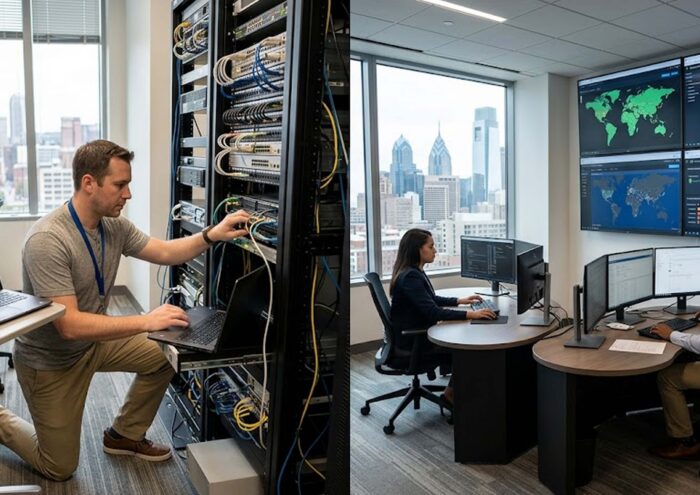
As businesses across Pennsylvania continue to grow—from corporate offices in Philadelphia to manufacturing facilities in Pittsburgh and healthcare systems in Harrisburg—the demand for reliable, secure, and scalable technology has never been higher.
One of the most important decisions organizations face is whether to rely on in-house IT teams or outsource to Managed Services providers.
Both options have advantages, but the right choice depends on your business size, goals, and operational needs. This guide breaks down the key differences to help Pennsylvania businesses make an informed decision.
Understanding the Two Models
Before comparing, it’s important to understand what each approach involves.
In-House IT
An internal IT team manages all aspects of your technology, including:
- Network and IT Infrastructure maintenance
- Troubleshooting and support
- Security management (IP Security)
- Hardware and software updates
Managed Services
A third-party provider like Instrata handles your IT needs remotely and/or on-site through a subscription-based model.
Services often include:
- 24/7 monitoring and support
- Network and Structured Cabling management
- Security and compliance
- Cloud and system optimization
- Data Centers support
Cost Comparison: Predictability vs Overhead
In-House IT Costs
Maintaining an internal IT team can be expensive.
Expenses Include:
- Salaries and benefits
- Training and certifications
- Hardware and software tools
- Overtime or emergency support costs
For many Pennsylvania businesses, especially mid-sized organizations, these costs can add up quickly.
Managed Services Costs
Managed Services offer a predictable monthly fee.
Benefits:
- Lower upfront investment
- No hiring or training costs
- Scalable pricing based on needs
This makes budgeting easier and often reduces overall IT expenses.
Expertise and Skill Set
In-House IT
Internal teams may have strong knowledge of your specific systems, but they can be limited in scope.
Challenges:
- Limited exposure to new Technologies
- Skill gaps in specialized areas (e.g., Data Centers, Radio Frequency)
- Difficulty keeping up with rapid technological changes
Managed Services
Providers offer access to a team of specialists with diverse expertise.
Advantages:
- Knowledge across multiple industries and systems
- Expertise in Structured Cabling, IP Security, and advanced infrastructure
- Continuous training on the latest technologies
For Pennsylvania businesses, this means access to enterprise-level expertise without hiring a large team.
Scalability and Flexibility
In-House IT
Scaling an internal team can be slow and costly.
Limitations:
- Hiring and onboarding delays
- Difficulty adjusting resources quickly
- Limited capacity during rapid growth
Managed Services
Managed providers are built for scalability.
Benefits:
- Easily adjust services as your business grows
- Support multi-location expansion
- Flexible service plans
This is especially valuable for growing businesses across Pennsylvania.
Response Time and Support
In-House IT
Internal teams may be available during business hours but can struggle with after-hours support.
Challenges:
- Limited availability outside office hours
- Slower response during peak demand
- Dependence on a small team
Managed Services
Most providers offer 24/7 monitoring and support.
Advantages:
- Immediate response to issues
- Proactive problem detection
- Reduced downtime
In industries like healthcare and logistics, where uptime is critical, this level of support is essential.
Proactive vs Reactive Approach
In-House IT
Internal teams often operate in a reactive mode—fixing issues after they occur.
Managed Services
Managed Services focus on prevention.
Key Features:
- Continuous system monitoring
- Early detection of potential issues
- Regular maintenance and updates
This proactive approach minimizes disruptions and improves overall performance.
Security and Compliance
In-House IT
Security depends on the expertise and resources of your internal team.
Risks:
- Limited cybersecurity knowledge
- Outdated security practices
- Difficulty keeping up with compliance requirements
Managed Services
Providers offer advanced IP Security and compliance support.
Benefits:
- Up-to-date security protocols
- Continuous monitoring for threats
- Support for industry regulations
For Pennsylvania businesses in regulated industries, this is a major advantage.
Integration with Infrastructure
Modern businesses rely on multiple interconnected systems.
In-House IT Challenges:
- Managing integration across systems
- Coordinating with external vendors
- Limited expertise in areas like Electricity/Utility Construction or Audio Visual Services and Solutions
Managed Services Advantages:
- Seamless integration across IT Infrastructure, Data Centers, and more
- Centralized management of all systems
- Reduced complexity
This unified approach improves efficiency and performance.
When In-House IT Makes Sense
In-house IT may be the right choice if your business:
- Has highly specialized internal systems
- Requires constant on-site IT presence
- Has the budget for a large, skilled team
- Operates on a smaller scale with minimal IT needs
When Managed Services Are the Better Choice
Managed Services are often ideal for businesses that:
- Are growing or scaling rapidly
- Need 24/7 support and monitoring
- Want to reduce IT costs and complexity
- Require expertise across multiple technologies
- Operate in high-demand environments
For most mid-sized and enterprise organizations in Pennsylvania, managed services provide greater flexibility and value.
The Hybrid Approach
Many businesses choose a hybrid model—combining in-house IT with Managed Services.
How It Works:
- Internal team handles day-to-day operations
- Managed provider supports infrastructure, security, and advanced systems
This approach offers the best of both worlds: internal familiarity and external expertise.
Real-World Applications in Pennsylvania
Across industries, businesses are leveraging managed services to improve operations:
- Philadelphia corporate offices: Reducing IT costs while improving uptime
- Pittsburgh manufacturing facilities: Supporting Radio Frequency and automation systems
- Healthcare providers statewide: Ensuring secure, reliable access to data
- Logistics hubs in Harrisburg: Maintaining real-time connectivity and performance
In each case, managed services help businesses operate more efficiently and scale with confidence.
Why Pennsylvania Businesses Choose Instrata
Instrata delivers comprehensive Managed Services tailored to the needs of Pennsylvania businesses.
What Sets Instrata Apart:
- Expertise across IT Infrastructure, Structured Cabling, and Data Centers
- Seamless integration with IP Security, AV systems, and more
- Scalable solutions designed for growth
- Proactive monitoring and support
- High-quality, standards-based service delivery
From Philadelphia to Pittsburgh, Allentown to Harrisburg, Instrata provides reliable, professional, and future-ready solutions.
Make the Right Choice for Your Business
Choosing between in-house IT and Managed Services is a strategic decision that impacts your efficiency, security, and growth.
For many Pennsylvania businesses, managed services offer the flexibility, expertise, and cost-efficiency needed to stay competitive in today’s technology-driven landscape.
Instrata provides end-to-end solutions across Structured Cabling, IP Security, Radio Frequency, IT Infrastructure, Electricity/Utility Construction, Managed Services, Data Centers, and Audio Visual Services and Solutions.
Contact us today to learn how structured cabling can transform your business operations