

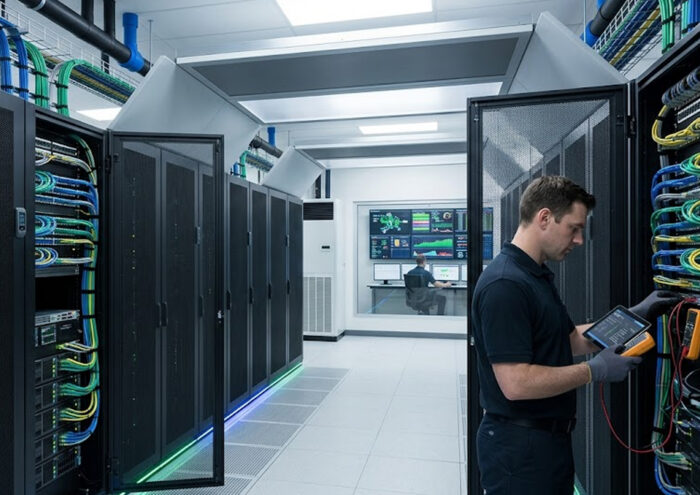
New Jersey businesses operate in one of the most competitive and densely connected regions in the United States. From financial institutions in Jersey City and Newark to pharmaceutical companies in Princeton and logistics hubs near Elizabeth and Edison, organizations depend on high-performing Data Centers to maintain operational continuity and competitive advantage.
As digital demands increase—driven by cloud computing, AI analytics, cybersecurity requirements, and high-density device environments—Data Center performance must evolve accordingly. Optimizing performance is not just about faster servers; it requires strategic alignment between IT Infrastructure, Structured Cabling, Radio Frequency, IP Security, Electricity/Utility Construction, Managed Services, and Audio Visual Services and Solutions.
Here’s how New Jersey organizations can optimize Data Center performance for speed, reliability, and scalability.
Strengthen Power Infrastructure and Redundancy
Power stability is foundational to Data Center performance. In New Jersey’s high-demand energy environment, facilities must prepare for grid strain, severe storms, and unexpected outages.
Optimization begins with:
- Dual utility feeds
- N+1 or 2N power redundancy
- Uninterruptible Power Supply (UPS) systems
- Backup generators with automated transfer switches
- Surge protection and proper grounding
Professional Electricity/Utility Construction planning ensures your power systems can handle both current loads and future expansion without risk of overload.
Reliable power directly improves uptime and protects critical hardware.
Upgrade Structured Cabling for High-Speed Connectivity
Even the most advanced hardware relies on efficient physical connections. Outdated or disorganized Structured Cabling can limit throughput and create performance bottlenecks.
Optimized cabling systems include:
- High-speed fiber backbone installations
- Organized rack layouts
- Clearly labeled cable pathways
- Redundant network routes
- Separation of power and data lines
Proper cable management also improves airflow, supporting cooling efficiency and reducing hardware strain.
Improve Cooling and Environmental Controls
Overheating reduces performance and shortens hardware lifespan. Data Centers must maintain optimal environmental conditions to maximize efficiency.
Key cooling strategies include:
- Hot aisle and cold aisle containment
- Precision cooling systems
- Redundant HVAC units
- Environmental monitoring sensors
- Real-time alert systems
New Jersey’s seasonal temperature fluctuations make advanced cooling strategies essential for consistent performance.
Optimize Network Architecture and IT Infrastructure
Efficient IT Infrastructure design eliminates single points of failure and improves data flow.
Best practices include:
- Redundant core switches and routers
- Virtualized server environments
- Load balancing across systems
- Network segmentation for security
- High-speed interconnects
A well-designed architecture reduces latency and improves application response times.
Integrate Hybrid Cloud and Edge Solutions
Many New Jersey businesses operate hybrid environments combining on-site Data Centers with cloud platforms.
Optimization strategies include:
- Direct cloud connectivity
- Automated failover systems
- Distributed workload management
- Secure VPN and encrypted connections
Balancing on-premises and cloud resources enhances scalability and improves disaster recovery capabilities.
Enhance Security and Monitoring Systems
Performance optimization must include security considerations. Integrated IP Security systems protect physical infrastructure, while cybersecurity measures protect digital assets.
Performance-enhancing security features include:
- Biometric access controls
- 24/7 surveillance monitoring
- Intrusion detection systems
- Encrypted data transmission
- Firewall and endpoint protection
When security systems are integrated into IT Infrastructure, they operate efficiently without hindering performance.
Strengthen Wireless and RF Support Systems
While Data Centers rely primarily on wired connections, Radio Frequency (RF) systems support:
- Wireless environmental sensors
- Technician mobility
- Secure monitoring devices
- IoT integration
Proper RF design ensures seamless communication between monitoring systems and management platforms.
Implement Proactive Managed Services
Ongoing optimization requires continuous monitoring. Professional Managed Services provide:
- 24/7 system oversight
- Predictive maintenance
- Firmware and software updates
- Capacity planning
- Rapid issue resolution
Proactive monitoring prevents small performance issues from escalating into major outages.
Improve Storage Efficiency and Data Management
As data volumes grow, storage optimization becomes critical.
Effective strategies include:
- Tiered storage solutions
- Data deduplication
- Automated archiving
- Scalable storage arrays
- Performance analytics monitoring
Efficient data management reduces latency and improves system responsiveness.
Streamline Rack Design and Space Utilization
Physical organization impacts airflow, cooling efficiency, and maintenance speed.
Optimized rack design includes:
- Logical equipment placement
- Cable management systems
- Clear labeling
- Expansion-ready layouts
Organized layouts reduce downtime during maintenance and upgrades.
Enhance Collaboration Through Integrated AV Systems
Enterprise Data Centers often include Network Operations Centers (NOCs). Integrated Audio Visual Services and Solutions improve operational oversight by enabling:
- Real-time system dashboards
- Video wall monitoring
- Incident response coordination
- Secure communication channels
Centralized visibility enhances response speed and decision-making accuracy.
Conduct Regular Performance Audits
Routine infrastructure audits identify inefficiencies before they impact performance.
Audits should evaluate:
- Power utilization
- Network throughput
- Cooling effectiveness
- Cabling integrity
- Security configurations
- Hardware lifecycle status
Regular assessments ensure continuous improvement.
Why New Jersey Businesses Trust Instrata
Across New Jersey—including Newark, Jersey City, Princeton, Edison, Trenton, and surrounding areas—organizations rely on Instrata for high-performance Data Center solutions.
Instrata delivers:
- Strategic Data Center design and optimization
- Enterprise-grade IT Infrastructure integration
- Advanced Structured Cabling installations
- Professional Electricity/Utility Construction coordination
- Integrated IP Security systems
- Radio Frequency engineering
- Audio Visual Services and Solutions
- Proactive Managed Services
By aligning performance, security, and scalability, Instrata helps New Jersey businesses operate with confidence and efficiency.
Maximize Performance and Minimize Risk
Optimizing Data Center performance requires a holistic approach that integrates power, connectivity, security, and proactive management.
If your New Jersey organization is experiencing performance limitations or planning infrastructure upgrades, Instrata is ready to help.