

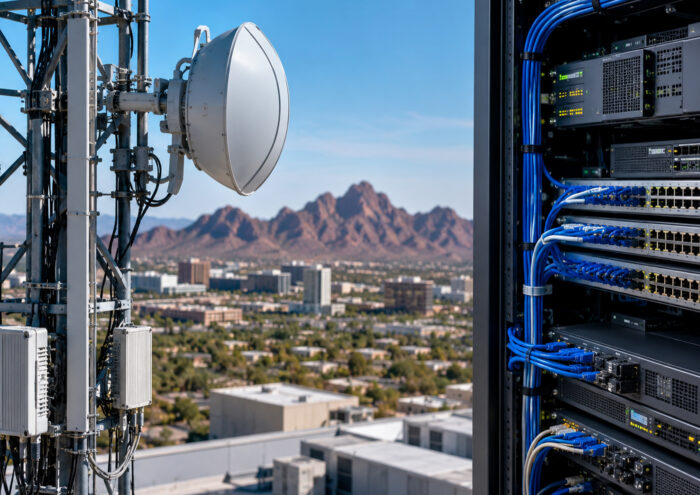
Arizona businesses rely on fast, secure, and scalable technology to keep operations moving. From corporate offices in Phoenix and Scottsdale to healthcare facilities in Tucson, logistics hubs in Tempe, industrial sites in Mesa, and enterprise campuses throughout the state, wireless performance is now a critical part of daily operations.
However, strong wireless connectivity does not happen by accident. It depends on careful Radio Frequency planning, reliable IT Infrastructure, professional Structured Cabling, secure systems, and ongoing support. When these elements work together, businesses gain stronger coverage, better performance, and a more dependable technology environment.
At Instrata, we help Arizona organizations integrate Radio Frequency into their IT Infrastructure with solutions that support wireless networks, IP Security, Data Centers, Managed Services, Electricity/Utility Construction, and Audio Visual Services and Solutions.
What Is Radio Frequency in IT Infrastructure?
Radio Frequency, often called RF, refers to the wireless signals used by devices to communicate. Wi-Fi networks, wireless access points, cellular systems, security devices, handheld scanners, sensors, smart building systems, and mobile tools all depend on RF signals.
In modern business environments, RF is not separate from IT Infrastructure. Instead, it is part of the larger technology ecosystem. Wireless access points connect back to switches, cabling, routers, firewalls, servers, monitoring systems, and management platforms.
Therefore, integrating RF into IT Infrastructure means designing wireless systems that work smoothly with the physical network, security systems, applications, devices, and future technology needs.
Why Arizona Businesses Need RF Integration
Arizona businesses operate in a wide range of environments, and each location creates different wireless challenges. A Phoenix office may need seamless Wi-Fi across multiple floors. Meanwhile, a Mesa industrial facility may need wireless coverage around equipment, production areas, and outdoor spaces. In Tucson, a healthcare facility may need dependable mobile device access for staff, patients, and administrative teams.
In addition, building materials, heat-sensitive equipment areas, large warehouse footprints, concrete walls, metal structures, neighboring networks, and high device density can all affect wireless performance.
Radio Frequency integration helps businesses:
- Improve Wi-Fi coverage
- Reduce wireless dead zones
- Support more connected devices
- Improve mobile workforce productivity
- Strengthen IP Security performance
- Support smart building Technologies
- Improve AV and collaboration tools
- Prepare infrastructure for future growth
- Reduce downtime and connectivity issues
Ultimately, RF integration helps Arizona organizations create wireless environments that are stable, secure, and ready to scale.
Start with an RF Assessment
Before installing access points or upgrading wireless equipment, businesses should begin with an RF assessment. This step helps identify how wireless signals move through the building and where performance issues may occur.
A professional RF assessment may evaluate:
- Building layout
- Wall and ceiling materials
- Device density
- Existing wireless coverage
- Sources of interference
- Access point placement
- Outdoor coverage needs
- Security requirements
- Future expansion plans
For example, a Scottsdale office may discover that conference rooms need stronger coverage for video meetings. Meanwhile, a Tempe logistics facility may find that warehouse shelving creates signal gaps for scanners and mobile devices.
As a result, an RF assessment gives businesses the information needed to design a stronger wireless infrastructure from the beginning.
Align RF Planning with IT Infrastructure
Radio Frequency works best when it is planned alongside the broader IT Infrastructure. Wireless systems depend on network switches, routers, firewalls, cabling, power, monitoring tools, and security policies.
If these systems are not aligned, wireless performance may suffer even when the access points are high quality. For instance, a business may install new wireless equipment but still experience slow performance because the network backbone cannot support the additional traffic.
A strong RF and IT Infrastructure plan should consider:
- Network bandwidth
- Switch capacity
- Firewall performance
- VLAN and network segmentation
- Cloud application usage
- Device management
- Security policies
- Monitoring and support needs
- Future scalability
Additionally, RF planning should account for how employees, guests, security systems, AV tools, and smart devices will use the wireless network.
Use Structured Cabling to Support Wireless Performance
Although Radio Frequency supports wireless communication, every wireless system still depends on a physical network foundation. Structured Cabling connects access points, switches, servers, security devices, AV systems, and monitoring tools.
Poor cabling can limit wireless performance, create intermittent issues, and make troubleshooting harder. By contrast, professional Structured Cabling gives businesses a clean, tested, and scalable foundation for RF systems.
Structured Cabling supports RF integration by improving:
- Access point connectivity
- Network reliability
- Troubleshooting speed
- Cable organization
- Future expansion
- Equipment room performance
- Data center connectivity
For Arizona businesses renovating offices, opening new facilities, or upgrading wireless systems, cabling should be planned early. Consequently, teams can avoid costly rework and ensure access points are installed in the right locations.
Integrate RF with IP Security Systems
Modern IP Security systems often rely on both wired and wireless connectivity. Cameras, access control devices, smart locks, mobile monitoring tools, sensors, and alarms all need dependable communication to protect people and property.
If Radio Frequency is not properly integrated into the infrastructure, security devices may experience delayed alerts, dropped connections, or limited visibility. Therefore, RF planning is especially important for businesses that depend on real-time security monitoring.
RF integration can support:
- Wireless cameras
- Mobile security devices
- Access control systems
- Smart locks and sensors
- Remote monitoring tools
- Security team communications
- Emergency notification systems
For example, an Arizona warehouse may need wireless support for security monitoring around loading docks. Similarly, a Phoenix commercial office may need reliable mobile access tools for facility teams. With the right RF design, IP Security systems become more dependable and easier to manage.
Support Audio Visual Services and Solutions
Hybrid meetings, video conferencing, digital signage, wireless presentation tools, and collaboration systems all depend on strong connectivity. As a result, Audio Visual Services and Solutions should be included in RF planning.
Meeting rooms often experience wireless strain because multiple users may connect laptops, tablets, phones, cameras, microphones, and presentation tools at the same time. Without proper RF design, teams may experience dropped calls, delayed screen sharing, poor audio, or unreliable room controls.
Radio Frequency integration can improve:
- Wireless presentation systems
- Video conferencing performance
- Guest Wi-Fi access
- Room scheduling panels
- Digital signage connectivity
- Mobile collaboration tools
- Smart meeting room devices
In addition, a reliable wireless environment supports connected digital platforms used for communication, reporting, marketing, and customer engagement.
Plan for Data Centers and Critical Systems
Arizona businesses may rely on Data Centers, server rooms, cloud platforms, and hybrid environments to support applications, storage, backups, and security systems. While most data center systems depend on wired infrastructure, RF can still support operational workflows.
Radio Frequency may be useful for mobile communication, asset tracking, environmental monitoring, facility access, and approved wireless tools in support spaces. However, these systems must be carefully planned to avoid interference and protect security.
Instrata helps businesses align RF planning with data center infrastructure, Structured Cabling, IP Security, power support, and Managed Services. As a result, critical systems remain better organized, more secure, and easier to support.
Coordinate RF with Electricity and Utility Construction
Wireless systems still need physical support. Access points, antennas, switches, cameras, AV equipment, and monitoring devices require power, mounting, grounding, pathways, and utility coordination.
Instrata’s Electricity/Utility Construction capabilities help Arizona businesses prepare facilities for modern technology systems. This is especially important for new construction, office renovations, industrial facilities, outdoor security areas, warehouse upgrades, and data center projects.
By coordinating utility construction with RF design and IT Infrastructure, businesses can reduce delays, avoid rework, and create cleaner installations.
Use Managed Services to Maintain RF Performance
Radio Frequency conditions can change over time. Businesses add devices, move teams, renovate spaces, install new equipment, and adopt new technologies. Because of this, RF integration should not be treated as a one-time project.
Instrata’s Managed Services help Arizona businesses monitor, maintain, and optimize technology systems after installation. With ongoing support, organizations can identify wireless issues early, adjust configurations, manage connected devices, and plan future upgrades.
Managed Services may support:
- Wireless performance reviews
- Network monitoring
- Device management
- Security updates
- Infrastructure troubleshooting
- IP Security support
- AV system maintenance
- Technology planning
Consequently, businesses can maintain stronger performance as their needs evolve.
Best Practices for RF Integration in Arizona
To integrate Radio Frequency successfully, businesses should take a structured approach rather than adding wireless devices randomly.
Key best practices include:
- Assess the RF environment first
Understand coverage, interference, building layout, and device needs before installation. - Design RF with IT Infrastructure in mind
Wireless systems should align with switches, cabling, firewalls, bandwidth, and security policies. - Plan Structured Cabling early
Access points and connected systems need reliable physical connections. - Include IP Security and AV requirements
Cameras, access control, meeting rooms, and collaboration tools should be part of the wireless strategy. - Prepare for future growth
Design systems that can support more users, devices, applications, and locations. - Maintain the system over time
Use Managed Services to keep RF and infrastructure performance aligned with business needs.
Why Arizona Businesses Choose Instrata
Instrata provides comprehensive technology solutions for commercial, enterprise, industrial, and residential clients across Arizona. Our team understands that reliable wireless performance depends on every layer of the technology environment working together.
Organizations choose Instrata for:
- Radio Frequency planning and optimization
- Scalable IT Infrastructure
- Professional Structured Cabling
- Integrated IP Security solutions
- Electricity/Utility Construction
- Managed Services
- Data Centers support
- Audio Visual Services and Solutions
- Modern Technologies for business growth
From Phoenix office upgrades and Scottsdale commercial properties to Tucson healthcare environments, Mesa industrial facilities, Tempe logistics operations, and enterprise projects across Arizona, Instrata delivers reliable, scalable, and professional technology solutions.
Build Stronger IT Infrastructure with RF Integration
Integrating Radio Frequency into IT Infrastructure helps Arizona businesses improve wireless coverage, strengthen security, support collaboration, reduce downtime, and prepare for future growth. More importantly, it ensures wireless systems are connected to the physical and digital infrastructure that keeps the organization running.
Whether your business is upgrading Wi-Fi, improving IP Security, expanding Structured Cabling, supporting Data Centers, modernizing AV systems, or planning a full infrastructure project, Instrata can help.
Contact us today to learn how structured cabling can transform your business operations