

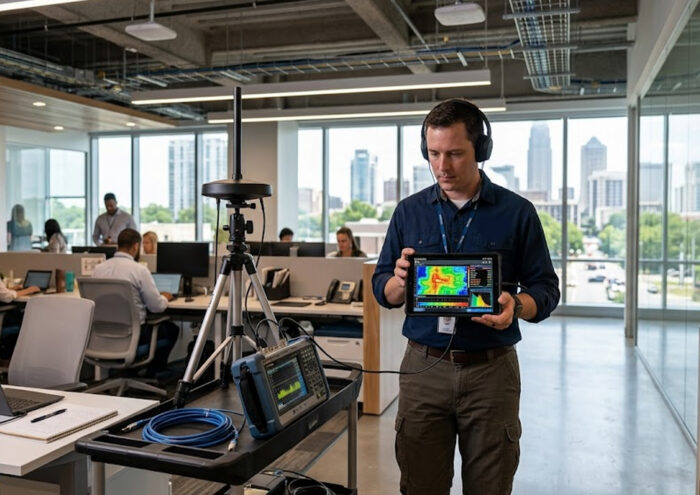
North Carolina businesses are expanding rapidly across industries such as finance, healthcare, manufacturing, higher education, and technology. From corporate offices in Charlotte and Raleigh to research facilities in Durham and industrial sites in Greensboro and Wilmington, reliable connectivity is critical to operational success.
As organizations adopt hybrid work models, IoT devices, cloud applications, and mobile workflows, Radio Frequency (RF) solutions play a vital role in strengthening overall IT Infrastructure. However, not all RF systems are created equal. Evaluating the right solution requires strategic planning, technical insight, and alignment with broader infrastructure goals.
Here’s how North Carolina businesses can properly evaluate Radio Frequency solutions to ensure performance, scalability, and long-term reliability.
Understand Your Operational Environment
The first step in evaluating RF solutions is understanding your specific environment.
Consider:
- Office layout and square footage
- Number of floors or buildings
- Warehouse or industrial space dimensions
- Building materials that may interfere with signals
- Indoor and outdoor coverage requirements
For example, manufacturing facilities in Greensboro may experience interference from heavy equipment, while multi-floor office buildings in Charlotte may require careful signal distribution planning.
Every environment presents unique RF challenges that must be addressed before selecting a solution.
Assess Device Density and Bandwidth Demands
Modern businesses operate in high-density device environments. Employees use laptops, smartphones, tablets, VoIP phones, and IoT devices simultaneously.
Evaluate:
- Total number of connected devices
- Peak usage times
- Cloud application reliance
- Video conferencing requirements
- Integration with Audio Visual Services and Solutions
High-density environments require advanced RF design to prevent congestion, latency, and signal overlap.
Conduct a Professional RF Site Survey
A professional site survey is one of the most important evaluation steps. RF site surveys include:
- Spectrum analysis
- Signal strength mapping
- Interference detection
- Heat mapping
- Channel utilization analysis
This data-driven approach ensures access points are placed strategically and that signal coverage is optimized throughout your facility.
Without a site survey, RF deployments often result in dead zones and inconsistent performance.
Evaluate Integration with IT Infrastructure
RF systems are not standalone solutions. They must integrate seamlessly with your broader IT Infrastructure.
When evaluating RF solutions, ensure compatibility with:
- Core switches and routers
- Network segmentation strategies
- Firewall and security protocols
- Cloud platforms
- On-site or regional Data Centers
Proper integration ensures strong performance while maintaining cybersecurity standards.
Consider Structured Cabling Support
Even wireless networks depend on wired backbones. Each wireless access point connects through Structured Cabling to your network infrastructure.
Evaluate whether your cabling system can support:
- Power over Ethernet (PoE) requirements
- High-speed uplinks
- Future bandwidth upgrades
- Scalable expansion
Outdated cabling can limit RF performance, regardless of how advanced your wireless equipment may be.
Prioritize Security and IP Security Integration
Wireless networks introduce potential security vulnerabilities. A comprehensive RF solution must support secure network segmentation and encryption.
Ensure the system includes:
- WPA3 encryption or equivalent
- Secure authentication protocols
- Guest network isolation
- Monitoring for unauthorized devices
- Integration with IP Security systems
For healthcare providers and financial institutions in North Carolina, maintaining secure wireless environments is essential for compliance and risk management.
Evaluate Scalability for Growth
North Carolina’s growing business landscape demands flexible infrastructure.
Your RF solution should allow for:
- Easy addition of access points
- Increased bandwidth capacity
- Support for IoT deployments
- Expansion into additional buildings or campuses
Scalable systems prevent costly redesigns as your business grows.
Ensure Reliable Power and Infrastructure Support
Wireless equipment depends on reliable power systems. Coordination with professional Electricity/Utility Construction ensures:
- Dedicated circuits for networking equipment
- Surge protection
- Backup power integration
- Proper grounding
Reliable electrical infrastructure reduces the risk of outages and equipment damage.
Monitor Performance with Managed Services
After deployment, continuous monitoring is critical. Professional Managed Services provide:
- Real-time performance monitoring
- Firmware updates
- Security patch management
- Capacity forecasting
- Rapid troubleshooting
Proactive oversight ensures your RF environment remains optimized and secure.
Analyze Total Cost of Ownership
When evaluating RF solutions, consider more than initial hardware costs.
Assess:
- Installation expenses
- Infrastructure upgrades
- Ongoing maintenance
- Energy consumption
- Scalability costs
A properly designed solution may require greater upfront investment but deliver long-term savings through reduced downtime and improved efficiency.
Common Warning Signs of Poor RF Planning
North Carolina businesses may need RF optimization if they experience:
- Frequent dropped Wi-Fi connections
- Slow performance during peak hours
- Inconsistent video conferencing quality
- Dead zones in key areas
- Security concerns with wireless access
These issues often stem from inadequate planning rather than insufficient internet bandwidth.
Why North Carolina Businesses Trust Instrata
Across North Carolina—including Charlotte, Raleigh, Durham, Greensboro, Wilmington, and Asheville—organizations rely on Instrata for advanced RF and infrastructure solutions.
Instrata delivers:
- Professional Radio Frequency site surveys and engineering
- Enterprise-grade IT Infrastructure integration
- Structured Cabling upgrades and design
- Advanced IP Security system coordination
- Reliable Electricity/Utility Construction support
- Data Center optimization
- Integrated Audio Visual Services and Solutions
- Proactive Managed Services
By combining wireless expertise with comprehensive infrastructure planning, Instrata ensures North Carolina businesses achieve reliable, high-performance connectivity.
Build a Strong Wireless Foundation
Radio Frequency solutions are critical to modern IT Infrastructure. When properly evaluated and engineered, RF systems improve productivity, enhance security, and support scalable growth.
If your North Carolina business is planning a wireless upgrade or experiencing connectivity challenges, Instrata is ready to help.