

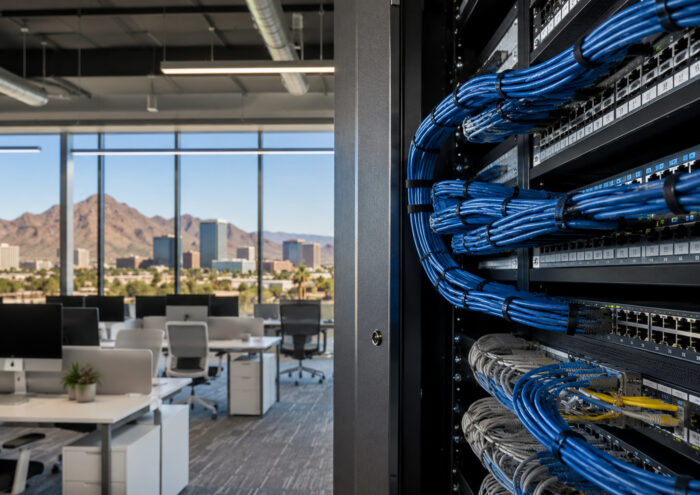
Choosing the right Structured Cabling for a large office is one of the most important technology decisions an Arizona business can make. Whether your company operates in Phoenix, Scottsdale, Tucson, Mesa, Tempe, Chandler, Glendale, or another growing business community, your cabling system affects network speed, cloud access, security, collaboration, and long-term scalability.
Large offices have more complex needs than small workspaces. They often include multiple departments, conference rooms, wireless access points, workstations, security cameras, access control systems, server rooms, training areas, and shared technology spaces. Therefore, cabling should never be treated as a basic wiring project. Instead, it should be planned as the foundation of your entire IT Infrastructure.
When designed correctly, Structured Cabling supports faster performance, easier troubleshooting, stronger IP Security, more reliable Audio Visual Services and Solutions, scalable Data Centers, and smoother Managed Services support.
Why Structured Cabling Matters for Large Offices
Large offices rely on many connected systems working together. Employees need fast access to files, cloud platforms, phones, video conferencing, printers, shared drives, wireless networks, and business applications. At the same time, facility teams may need IP cameras, access control, digital signage, and building technology systems.
Without professional Structured Cabling, large offices may experience:
- Slow network speeds
- Dropped connections
- Poor Wi-Fi performance
- Unreliable conference room systems
- Security camera interruptions
- Difficult troubleshooting
- Messy network closets
- Limited room for expansion
- Higher long-term support costs
For example, a corporate office in Phoenix may need cabling for hundreds of workstations and multiple collaboration spaces. Meanwhile, a growing business in Scottsdale may need infrastructure that supports hybrid teams, executive conference rooms, cloud applications, and secure access control. Similarly, a large office in Tucson may require scalable cabling for future departments and technology upgrades.
In each case, the right cabling system helps the office operate more efficiently.
Start with a Professional Network Assessment
Before choosing a cabling solution, begin with a professional assessment of your office layout, technology needs, and future growth plans. This helps determine what type of cabling, pathways, equipment rooms, network drops, and backbone connections your business requires.
A proper assessment should review:
- Number of employees and workstations
- Office layout and department locations
- Conference rooms and training spaces
- Wireless access point needs
- IP Security camera locations
- Access control requirements
- Server room or network closet design
- Cloud and application usage
- Future expansion plans
- Data center or storage requirements
Additionally, the assessment should consider how employees move through the space and how technology supports daily workflows. This planning step helps prevent underbuilding the network and reduces the risk of expensive changes later.
Choose Cabling That Supports Speed and Bandwidth
Large offices need cabling that can support high traffic. Employees may be using cloud applications, video calls, file sharing, VoIP phones, collaboration platforms, and connected devices all at once. Consequently, bandwidth matters.
Common cabling options include Cat6, Cat6A, and fiber optic cabling. Cat6 is often suitable for many office environments, while Cat6A may be preferred for higher performance and future bandwidth needs. Fiber optic cabling is valuable for backbone connections, long-distance runs, data centers, and high-speed network links.
The right choice depends on:
- Current network speed requirements
- Future bandwidth expectations
- Distance between network areas
- Number of users and devices
- Data center or server room needs
- Cloud application usage
- Budget and scalability goals
Moreover, large offices should plan for growth. Choosing cabling only for today’s needs may limit tomorrow’s performance.
Plan for Scalable IT Infrastructure
A large office network should be able to grow as your business grows. Therefore, scalability should be a major factor when choosing Structured Cabling.
Scalable cabling can support:
- Additional employees
- More workstations
- Expanded Wi-Fi coverage
- New conference rooms
- Additional IP Security cameras
- Access control expansion
- Digital signage
- Data center upgrades
- Future Technologies
A scalable system gives your business more foothold as new users, applications, and devices are added over time.
For Arizona companies in fast-growing markets such as Phoenix, Chandler, Tempe, and Scottsdale, future-ready cabling can help prevent costly rework during expansions or office redesigns.
Consider Wireless Access Point Placement
Even wireless networks depend on cabling. Every access point needs a reliable connection back to the network. In large offices, poor access point placement can lead to weak Wi-Fi, dead zones, and inconsistent performance.
Structured Cabling should support wireless access points in the right locations based on office layout, wall materials, device density, and employee movement.
Additionally, Radio Frequency planning may be useful for large offices with high wireless demand. RF planning helps reduce interference, improve coverage, and support mobile devices more reliably.
This is especially important for:
- Open office environments
- Multi-floor buildings
- Training rooms
- Conference centers
- Shared workspaces
- High-density employee areas
- Large common spaces
When cabling and Radio Frequency planning work together, wireless performance becomes much more dependable.
Include IP Security in the Cabling Plan
Modern IP Security systems should be included early in the cabling design. Cameras, access control systems, intercoms, and monitoring platforms all need reliable network connections.
Structured Cabling can support IP Security through:
- Dedicated camera drops
- Power over Ethernet connections
- Access control cabling
- Secure equipment pathways
- Scalable camera expansion
- Organized patch panels
- Reliable device connectivity
For large Arizona offices, IP Security may be needed at entrances, exits, parking areas, reception spaces, server rooms, executive areas, storage rooms, and employee-only zones.
Furthermore, planning security cabling early allows businesses to place devices where they are most effective instead of working around infrastructure limitations later.
Support Audio Visual Services and Solutions
Large offices often rely heavily on Audio Visual Services and Solutions. Conference rooms, boardrooms, huddle spaces, training rooms, and digital signage systems all need dependable connectivity.
Structured Cabling may support AV systems such as:
- Video conferencing cameras
- Displays and projectors
- Speakers and microphones
- Control panels
- Wireless presentation tools
- Digital signage
- Training room technology
- Video walls
Because AV systems often rely on the same network as other business technologies, cabling should be designed to support clear audio, sharp video, stable conferencing, and easy room control.
As a result, teams spend less time troubleshooting meeting room issues and more time collaborating.
Design Clean Network Closets and Equipment Rooms
In large offices, network closets and equipment rooms can become cluttered quickly if they are not planned properly. Clean design improves performance, troubleshooting, airflow, and future expansion.
A professional cabling installation should include:
- Organized racks
- Labeled cables
- Patch panels
- Proper cable management
- Clear documentation
- Adequate space for equipment
- Room for future growth
- Proper pathways and supports
In addition, clean equipment rooms make it easier for internal IT teams and Managed Services providers to maintain the network. When everything is labeled and organized, issues can be resolved faster.
Think About Data Centers and Server Rooms
Some large offices include server rooms or smaller Data Centers to support applications, storage, backups, cloud connectivity, and business systems. These environments need cabling designed for uptime, airflow, security, and scalability.
Structured Cabling for Data Centers may include:
- Fiber optic backbone connections
- Rack-to-rack cabling
- Server connectivity
- Network redundancy
- Clean cable management
- Patch panel organization
- Documentation
- Expansion capacity
For Arizona businesses that depend on sensitive data, cloud access, financial systems, healthcare records, or enterprise platforms, data center cabling should be carefully planned from the beginning.
Ask About Testing and Certification
A professional Structured Cabling installation should include testing and certification. This verifies that the cabling performs as expected and meets the needs of your network.
Testing can confirm:
- Cable performance
- Proper termination
- Signal quality
- Fiber optic performance
- Connection reliability
- Network speed capability
- Installation accuracy
Additionally, certification documentation gives IT teams a reliable record of the installation. This is helpful for troubleshooting, future upgrades, and long-term maintenance.
Coordinate Power and Utility Requirements
Structured Cabling also depends on pathways, conduit, grounding, power coordination, and equipment room planning. Therefore, Electricity/Utility Construction should be considered early in large office projects.
This is especially important for:
- New office buildouts
- Renovations
- Network closet expansions
- Data center upgrades
- Outdoor security systems
- Multi-floor offices
- Large conference rooms
- Campus-style properties
By coordinating cabling with electrical and utility planning, businesses can avoid delays, reduce rework, and create a stronger infrastructure foundation.
Why Arizona Businesses Choose Instrata
Instrata helps Arizona businesses design, install, and support reliable Structured Cabling and technology infrastructure. From Phoenix and Scottsdale to Tucson, Mesa, Tempe, Chandler, Glendale, and surrounding communities, Instrata supports commercial, enterprise, industrial, and residential clients with scalable technology solutions.
Instrata specializes in:
- Structured Cabling
- IP Security
- Radio Frequency
- IT Infrastructure
- Electricity/Utility Construction
- Technologies
- Managed Services
- Data Centers
- Audio Visual Services and Solutions
By bringing these services together, Instrata helps organizations avoid the complexity of working with disconnected vendors. Instead, businesses can rely on one experienced partner for cabling, infrastructure, security, managed IT, data centers, RF planning, AV systems, and utility coordination.
Additionally, Instrata serves clients across North Carolina, South Carolina, New Jersey, New York, Pennsylvania, Maryland, and Virginia, making it a strong choice for regional and multi-location organizations.
Build a Scalable Office Network with Instrata
Choosing Structured Cabling for a large office in Arizona requires careful planning. The right system should support speed, scalability, wireless coverage, IP Security, Audio Visual Services and Solutions, Data Centers, Managed Services, Radio Frequency planning, Electricity/Utility Construction, and future Technologies.
For Arizona businesses that need dependable performance and room to grow, professional cabling is a smart investment.
Contact us today to learn how structured cabling can transform your business operations