

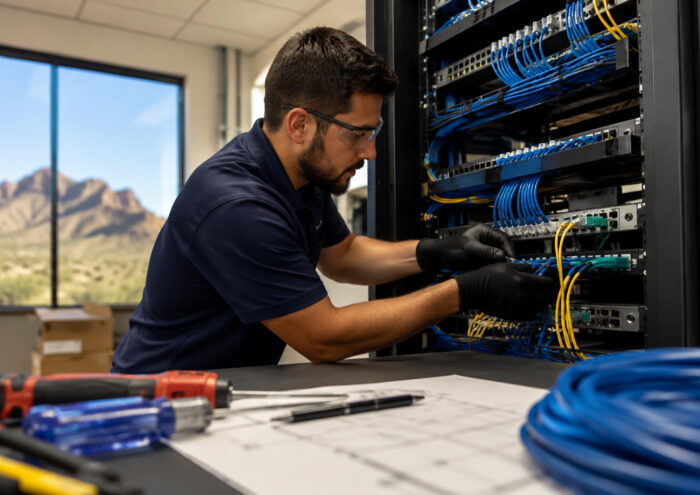
Arizona businesses rely on fast, secure, and scalable technology to keep operations running smoothly. From corporate offices in Phoenix and Scottsdale to healthcare facilities in Tucson, logistics centers in Tempe, industrial buildings in Mesa, and enterprise campuses throughout the state, dependable connectivity starts with one critical foundation: Structured Cabling.
Although cabling is often hidden behind walls, above ceilings, or inside network rooms, it affects nearly every part of your technology environment. Poor cabling can lead to slow networks, unreliable Wi-Fi, security system issues, messy equipment rooms, and expensive repairs later.
At Instrata, we help Arizona businesses design, install, upgrade, and maintain Structured Cabling systems that support modern IT Infrastructure, IP Security, Radio Frequency performance, Data Centers, Managed Services, and Audio Visual Services and Solutions.
Why Structured Cabling Matters for Arizona Businesses
Structured Cabling is the organized system of cables, racks, patch panels, pathways, outlets, and network rooms that connect your business technology. It supports computers, phones, wireless access points, cameras, access control devices, servers, AV systems, cloud platforms, and smart building Technologies.
Without a professional cabling plan, businesses may experience performance issues that are difficult to diagnose. In many cases, the problem is not the internet provider, software platform, or device. Instead, it is the physical infrastructure behind the scenes.
A strong Structured Cabling system helps businesses:
- Improve network speed and reliability
- Reduce downtime and service interruptions
- Support future technology upgrades
- Make troubleshooting faster
- Improve network room organization
- Support IP Security and AV systems
- Strengthen long-term scalability
For Arizona organizations planning office renovations, warehouse buildouts, data center upgrades, or new construction, cabling should be treated as a strategic investment rather than an afterthought.
Mistake #1: Skipping the Planning Phase
One of the most common Structured Cabling mistakes is starting installation without a clear design. This often leads to poor cable routes, limited capacity, messy network rooms, and costly rework.
Before installation begins, businesses should consider current needs and future growth. For example, a Phoenix office may only need 30 workstations today. However, if that same company plans to add departments, conference rooms, access control, wireless access points, and security cameras, the cabling system must be designed to support that expansion.
A proper cabling plan should account for:
- Workstation locations
- Network rooms and equipment racks
- Wireless access point placement
- IP Security camera locations
- AV and conference room needs
- Data center or server room connections
- Power and pathway requirements
- Future expansion capacity
By planning early, Arizona businesses can avoid delays, reduce disruption, and build a cleaner technology foundation.
Mistake #2: Using Low-Quality or Outdated Cabling
Not all cabling is designed for modern business demands. Older cables may not support today’s bandwidth needs, especially when businesses rely on cloud platforms, video conferencing, security cameras, wireless systems, and connected devices.
Using outdated or low-quality materials may save money upfront. However, it can create performance problems and higher replacement costs later.
Professional Structured Cabling should be selected based on:
- Network speed requirements
- Building layout
- Device density
- Application demands
- Data center or server needs
- Future scalability
- Industry standards
- Environmental conditions
In Arizona, facilities may include office buildings, warehouses, industrial sites, medical spaces, schools, and retail properties. Therefore, the cable type and installation method should match the environment.
Mistake #3: Poor Cable Organization
Messy cabling is more than an appearance issue. Tangled cables, unlabeled connections, and overcrowded racks can make troubleshooting slower and increase the risk of accidental disconnections.
For busy IT managers and facility teams, poor organization can turn a simple repair into a time-consuming problem. Additionally, messy cabling can restrict airflow in network rooms and server areas, which may affect equipment performance.
A clean cabling system should include:
- Proper labeling
- Organized patch panels
- Neat cable routing
- Rack management
- Clear documentation
- Accessible service paths
- Room for future additions
With proper organization, businesses can save time, reduce confusion, and make future upgrades easier.
Mistake #4: Ignoring Future Growth
Many businesses install only what they need right now. While that may seem efficient, it can quickly become a problem when the company grows, adds new devices, or expands into additional spaces.
Arizona businesses are often scaling quickly, especially in areas such as Phoenix, Scottsdale, Tempe, Mesa, Chandler, and Tucson. As a result, cabling systems should be designed with growth in mind.
Future-ready cabling can support:
- Additional employees
- More workstations
- Expanded Wi-Fi coverage
- New IP Security cameras
- Access control systems
- Audio Visual Services and Solutions
- Data Centers connectivity
- Smart building Technologies
- Cloud-based systems
Ultimately, planning for future growth helps businesses avoid repeated construction, downtime, and unnecessary expenses.
Mistake #5: Forgetting About Radio Frequency Needs
Wireless systems still depend on wired infrastructure. Every wireless access point needs a reliable network connection, and that connection usually depends on Structured Cabling.
If cabling is not planned around wireless coverage, businesses may end up with access points in poor locations or limited ability to expand Wi-Fi later. In addition, Arizona buildings with concrete walls, metal framing, large warehouses, or multi-floor layouts may require careful Radio Frequency planning.
RF planning helps determine where wireless access points should be placed and how signals move through a space. When Radio Frequency planning and Structured Cabling work together, businesses gain stronger coverage, fewer dead zones, and better wireless performance.
This is especially important for:
- Offices
- Warehouses
- Healthcare facilities
- Schools
- Retail spaces
- Industrial buildings
- Multi-tenant properties
- Data center support spaces
Mistake #6: Overlooking IP Security Requirements
Modern IP Security systems rely on cabling to connect cameras, access control devices, intercoms, sensors, alarms, and monitoring platforms. If security needs are not included during cabling design, businesses may face limited coverage, difficult installations, or unreliable system performance.
For example, a Mesa warehouse may need cameras near loading docks, access control at employee entrances, and monitoring in storage areas. Meanwhile, a Scottsdale office may need secure access points, lobby cameras, and visitor management systems. In both cases, cabling must be planned around security goals.
Structured Cabling supports IP Security by helping connect:
- Surveillance cameras
- Access control readers
- Door controllers
- Intercom systems
- Monitoring stations
- Video storage systems
- Security dashboards
- Remote viewing tools
As a result, businesses gain better visibility, stronger protection, and a more scalable security environment.
Mistake #7: Not Coordinating Cabling with Electricity and Utility Construction
Structured Cabling does not exist in isolation. It must work alongside power, grounding, conduit, pathways, equipment rooms, and utility infrastructure.
Failing to coordinate cabling with Electricity/Utility Construction can lead to project delays, safety issues, limited pathways, or expensive changes after installation begins. This is especially important in new construction, tenant improvements, industrial facilities, and data center projects.
Instrata helps Arizona businesses coordinate technology systems with electrical and utility needs from the beginning. Consequently, projects are cleaner, more efficient, and better prepared for long-term performance.
Mistake #8: Neglecting Data Center and Server Room Design
Small server rooms and large Data Centers both depend on clean, organized, and properly tested cabling. Poor cable management can block airflow, complicate maintenance, and increase downtime risk.
Data center cabling should be designed for performance, redundancy, airflow, and future expansion. In addition, rack layouts, patch panels, cable trays, power distribution, and cooling needs should be considered together.
Arizona businesses upgrading server rooms or deploying data center infrastructure should avoid:
- Overcrowded racks
- Unlabeled cables
- Poor airflow
- Limited patch panel capacity
- Improper cable routing
- Lack of documentation
- No room for expansion
A professional cabling approach helps protect critical systems and improves business continuity.
Mistake #9: Treating AV Systems as a Separate Project
Modern workplaces depend on conference rooms, training spaces, digital signage, displays, speakers, microphones, video conferencing tools, and room scheduling systems. These Audio Visual Services and Solutions rely on strong cabling and network connectivity.
If AV needs are not included in cabling plans, meeting rooms may experience connection issues, poor display performance, unreliable audio, or limited flexibility.
Structured Cabling should support:
- Video conferencing equipment
- Displays and projectors
- Speakers and microphones
- Room control systems
- Wireless presentation tools
- Digital signage
- Collaboration platforms
Additionally, reliable cabling supports connected digital platforms used for communication, reporting, marketing, and customer engagement.
Mistake #10: Installing Cabling Without Ongoing Support
Even a well-designed cabling system needs documentation, maintenance, and support over time. As businesses add devices, renovate spaces, upgrade systems, or change layouts, cabling environments can become disorganized without proper management.
Instrata’s Managed Services help Arizona organizations maintain technology systems more effectively. With ongoing support, businesses can monitor performance, troubleshoot faster, plan upgrades, and keep infrastructure aligned with operational needs.
Managed Services can help support:
- Network performance
- Device connectivity
- Infrastructure documentation
- Security systems
- Wireless systems
- AV environments
- Data center connectivity
- Future technology planning
For busy IT teams, this support reduces stress and helps prevent small issues from becoming larger problems.
Best Practices for Structured Cabling in Arizona
To avoid common mistakes, businesses should take a proactive and professional approach to cabling design and installation.
Key best practices include:
- Plan before installation begins
Evaluate current needs, future growth, and all connected systems. - Use the right cabling materials
Choose cabling that supports modern bandwidth and long-term scalability. - Label and document everything
Clear documentation makes troubleshooting and expansion much easier. - Coordinate cabling with power and utilities
Align technology pathways with Electricity/Utility Construction needs. - Include wireless, security, AV, and data center requirements
Build one integrated infrastructure plan instead of separate disconnected systems. - Work with experienced professionals
Professional installation reduces risk, improves performance, and supports compliance with best practices.
Why Arizona Businesses Choose Instrata
Instrata provides comprehensive technology solutions for commercial, enterprise, industrial, and residential clients across Arizona. Our team understands that reliable technology starts with a strong foundation.
Organizations choose Instrata for:
- Professional Structured Cabling
- Scalable IT Infrastructure
- IP Security integration
- Radio Frequency planning
- Electricity/Utility Construction
- Managed Services
- Data Centers support
- Audio Visual Services and Solutions
- Modern Technologies for business growth
From Phoenix office buildouts and Scottsdale commercial upgrades to Tucson healthcare environments, Mesa industrial facilities, Tempe logistics operations, and data center projects across Arizona, Instrata delivers reliable, scalable, and professional technology solutions.
Build a Better Cabling Foundation with Instrata
Avoiding Structured Cabling mistakes starts with proper planning, professional installation, clean organization, and long-term support. When cabling is designed correctly, Arizona businesses gain better network performance, stronger security, improved wireless coverage, more reliable AV systems, and a technology foundation built for growth.
Whether your organization is moving offices, renovating a facility, upgrading IT Infrastructure, improving IP Security, expanding wireless systems, supporting Data Centers, or planning new Technologies, Instrata can help.
Contact us today to learn how structured cabling can transform your business operations