

Enterprise businesses in New York depend on fast, secure, and reliable networks to keep operations moving. From corporate offices in Manhattan and financial firms in Midtown to healthcare facilities in Brooklyn, retail operations in Queens, industrial sites in the Bronx, and enterprise campuses across Long Island and Westchester, network performance is essential.
However, strong enterprise networks do not happen by accident. Behind every dependable connection is a carefully planned Structured Cabling system. This cabling foundation connects people, devices, applications, security systems, wireless access points, servers, and business-critical platforms.
At Instrata, we help New York organizations design, install, upgrade, and maintain Structured Cabling systems that support scalable IT Infrastructure, reliable IP Security, optimized Radio Frequency performance, efficient Managed Services, secure Data Centers, professional Electricity/Utility Construction, and modern Audio Visual Services and Solutions.
What Is Structured Cabling?
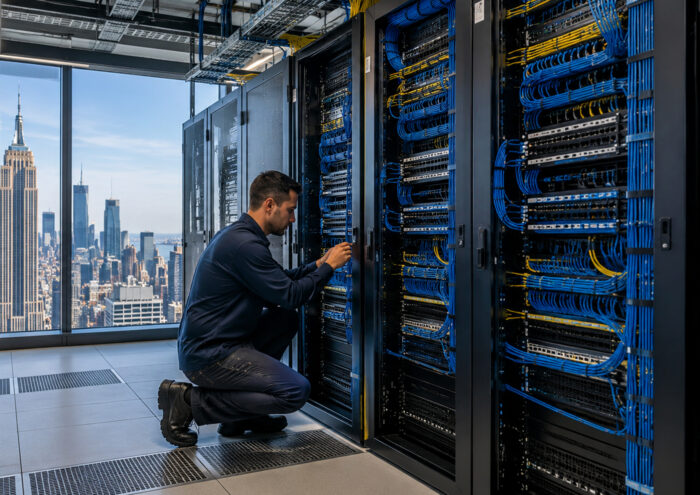
Structured Cabling is the organized system of cables, racks, patch panels, outlets, pathways, and network rooms that connect technology throughout a business. Unlike temporary wiring or messy point-to-point connections, Structured Cabling is designed for performance, documentation, scalability, and long-term reliability.
A professional cabling system may support:
- Computers and workstations
- Phones and voice systems
- Wireless access points
- IP Security cameras
- Access control systems
- Servers and storage devices
- Data Centers
- AV systems and conference rooms
- Smart building Technologies
- Cloud-connected applications
For enterprise networks in New York, Structured Cabling acts as the physical backbone that keeps systems connected and manageable.
Why Enterprise Networks Need a Strong Cabling Foundation
Enterprise networks handle large volumes of users, applications, devices, and data. As a result, the physical infrastructure behind the network must be strong enough to support constant demand.
Without proper cabling, businesses may experience slow speeds, dropped connections, unreliable Wi-Fi, security camera failures, messy network closets, and frequent troubleshooting issues. Over time, these problems can reduce productivity and increase technology costs.
Professional Structured Cabling helps enterprise networks by improving:
- Network reliability
- Data transmission speed
- Troubleshooting efficiency
- System organization
- Security system performance
- Wireless access point connectivity
- Future scalability
- Business continuity
For a Manhattan financial firm, cabling may support secure trading systems, conference rooms, and private networks. Meanwhile, a Brooklyn healthcare facility may rely on cabling for patient systems, IP Security, wireless devices, and administrative platforms. In both cases, the network depends on a clean and reliable foundation.
Structured Cabling Supports Scalable IT Infrastructure
Enterprise organizations need IT Infrastructure that can grow with the business. As companies add employees, departments, cloud platforms, devices, and office locations, the cabling system must be ready to support that expansion.
A weak cabling foundation can make growth more expensive and disruptive. However, a properly designed Structured Cabling system gives businesses room to add network drops, access points, security devices, AV tools, and server connections with less rework.
Scalable cabling can support:
- Multi-floor offices
- New workstations
- Additional network equipment
- Hybrid work systems
- Cloud applications
- Smart building systems
- Multi-site connectivity
- Future bandwidth demands
In New York, where office space is often dense and infrastructure upgrades can be disruptive, planning ahead is especially important. Therefore, enterprise cabling should be designed with both current needs and future expansion in mind.
Better Cabling Improves Network Performance
Enterprise networks must move data quickly and reliably. Employees expect fast access to applications, files, video calls, cloud tools, and communication platforms. If the cabling system is outdated or poorly installed, the entire network may underperform.
Structured Cabling improves performance by creating stable pathways for data transmission. Additionally, professional testing and labeling help ensure each connection is ready to support business demands.
Better cabling can help reduce:
- Slow file transfers
- Dropped connections
- Application delays
- Voice and video issues
- Unstable wireless performance
- Recurring network errors
- Troubleshooting delays
Consequently, IT teams gain a more dependable environment, and employees experience fewer disruptions during the workday.
Structured Cabling Strengthens IP Security
Modern IP Security systems depend on enterprise networks. Surveillance cameras, access control readers, intercoms, sensors, alarms, and monitoring platforms all require reliable connections.
If cabling is poorly planned, security devices may fail, video feeds may drop, or access control systems may respond slowly. For enterprise businesses, these issues can create serious risks.
Structured Cabling supports IP Security by connecting:
- Video surveillance cameras
- Door access systems
- Badge readers
- Smart locks
- Intercom systems
- Security monitoring stations
- Video storage systems
- Remote monitoring platforms
For New York office towers, healthcare environments, retail spaces, schools, commercial properties, and enterprise facilities, dependable security infrastructure is essential. As a result, IP Security should always be included in the cabling design process.
Structured Cabling and Radio Frequency Work Together
Wireless networks still depend on wired infrastructure. Every access point needs a stable connection back to the network, and that connection is usually supported by Structured Cabling.
Radio Frequency planning determines where wireless access points should be placed for strong coverage and reduced interference. Structured Cabling then ensures those access points are connected properly.
Together, cabling and RF planning help improve:
- Wi-Fi coverage
- Wireless speed
- Device capacity
- Guest network access
- Mobile workforce performance
- Smart building connectivity
- Warehouse and logistics communication
This is especially important in New York buildings, where concrete, steel, elevators, neighboring networks, and high device density can affect wireless performance. With coordinated RF and cabling design, enterprise networks become more reliable and easier to scale.
Data Centers Depend on Organized Cabling
Enterprise networks often connect to Data Centers, server rooms, cloud systems, and hybrid environments. In these spaces, cabling quality directly affects uptime, airflow, troubleshooting, and long-term performance.
Messy or unlabeled cables can slow down maintenance and increase the risk of accidental disconnections. In contrast, organized cabling makes data center environments easier to manage and expand.
A strong data center cabling system should be:
- Clearly labeled
- Properly routed
- Tested for performance
- Organized for airflow
- Designed for redundancy
- Easy to trace
- Built for future growth
For New York businesses managing mission-critical systems, clean cabling can help reduce downtime and support business continuity.
Cabling Supports Audio Visual Services and Solutions
Enterprise meetings, training spaces, boardrooms, digital signage, command centers, and hybrid work environments all depend on reliable network infrastructure. Therefore, Audio Visual Services and Solutions should be included in the Structured Cabling plan.
AV systems may rely on cabling for displays, cameras, microphones, speakers, room controls, scheduling panels, and video conferencing tools. When cabling is weak or poorly organized, meeting technology may become unreliable.
Structured Cabling supports AV by improving:
- Video conferencing performance
- Display connectivity
- Audio reliability
- Room control systems
- Digital signage
- Wireless presentation tools
- Collaboration platforms
In addition, a dependable network foundation supports connected channels used for communication, reporting, marketing, and customer engagement.
Managed Services Are More Effective with Strong Cabling
Instrata’s Managed Services help enterprise organizations monitor, maintain, and optimize technology systems. However, ongoing support is much more effective when the physical infrastructure is clean, documented, and reliable.
If cables are tangled, unlabeled, damaged, or outdated, troubleshooting takes longer. Additionally, recurring issues may be harder to identify. Professional Structured Cabling gives Managed Services teams a stronger foundation for support and planning.
Managed Services can help with:
- Network monitoring
- Device management
- Security updates
- Performance reviews
- Troubleshooting
- Infrastructure documentation
- Data center support
- Technology planning
Ultimately, strong cabling helps enterprise IT teams work faster and more efficiently.
Electricity and Utility Construction Support Cabling Projects
Structured Cabling must work alongside power, grounding, pathways, conduit, equipment rooms, and utility infrastructure. Without proper coordination, businesses may face delays, limited pathways, unsafe installations, or costly rework.
Instrata’s Electricity/Utility Construction capabilities help New York businesses support technology systems from the ground up. This is especially important for office renovations, enterprise buildouts, data center upgrades, security deployments, industrial facilities, and large infrastructure projects.
By coordinating utility needs with Structured Cabling, IT Infrastructure, IP Security, Radio Frequency planning, and Managed Services, businesses can create cleaner and more reliable installations.
Why New York Enterprises Choose Instrata
Instrata provides comprehensive technology solutions for commercial, enterprise, industrial, and residential clients across New York. Our team understands that enterprise networks depend on every layer of infrastructure working together.
Organizations choose Instrata for:
- Professional Structured Cabling
- Scalable IT Infrastructure
- Integrated IP Security
- Radio Frequency planning
- Electricity/Utility Construction
- Managed Services
- Data Centers support
- Audio Visual Services and Solutions
- Modern Technologies for business growth
From Manhattan enterprise offices and Brooklyn healthcare facilities to Queens commercial spaces, Bronx industrial sites, Long Island campuses, and Westchester business environments, Instrata delivers reliable technology solutions built for performance, security, and scalability.
Build a Stronger Enterprise Network with Instrata
Structured Cabling supports enterprise networks by creating a stable, organized, and scalable foundation for business technology. It improves performance, strengthens IP Security, supports wireless systems, protects Data Centers, improves AV reliability, and helps IT teams manage systems more efficiently.
Whether your New York organization is expanding office space, upgrading IT Infrastructure, improving IP Security, supporting Data Centers, modernizing AV systems, or planning a larger technology project, Instrata can help.