

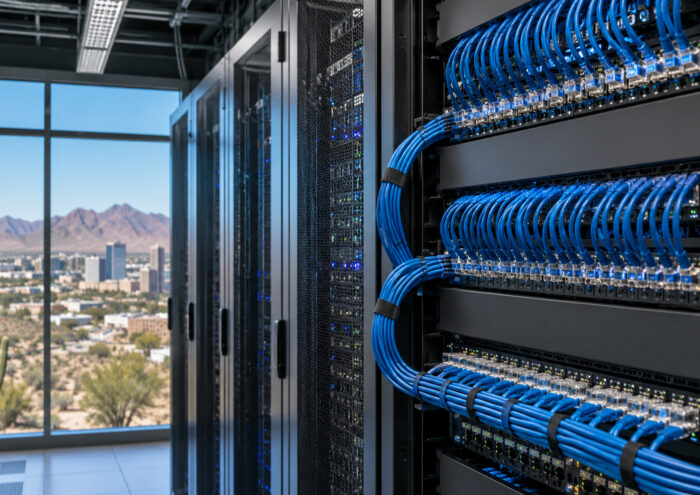
Cloud connectivity is now a daily requirement for businesses across Arizona. From Phoenix and Scottsdale to Tucson, Mesa, Tempe, Chandler, Glendale, and growing industrial corridors throughout the state, organizations rely on cloud platforms to access files, run applications, manage communications, support remote teams, and protect business data.
But while cloud systems may seem virtual, their performance depends heavily on physical infrastructure. Behind every fast upload, smooth video call, secure login, and reliable cloud application is a network foundation that must be properly designed, installed, and maintained.
That is where Structured Cabling becomes essential.
For Arizona businesses investing in cloud-based Technologies, strong cabling is not just a technical detail. It is the backbone that supports speed, security, scalability, and business continuity.
Why Cloud Connectivity Starts with Physical Infrastructure
Cloud platforms depend on strong local networks. Employees may be using software hosted offsite, but they still connect through routers, switches, firewalls, wireless access points, servers, and cabling.
If the physical network is outdated or poorly installed, cloud performance can suffer.
Common problems include:
- Slow access to cloud applications
- Dropped video meetings
- Poor VoIP call quality
- Delayed file syncing
- Weak wireless performance
- Security camera interruptions
- Unstable access to remote systems
- Increased downtime and support requests
For Arizona companies using cloud-based accounting tools, CRM systems, healthcare platforms, inventory software, collaboration suites, security systems, or data backup solutions, reliable IT Infrastructure is critical.
Professional Structured Cabling helps ensure that data moves efficiently between users, devices, applications, and cloud services.
What Is Structured Cabling?
Structured Cabling is an organized system of cabling and connection hardware that supports communication across a building, campus, data center, warehouse, or industrial facility.
Instead of using scattered wiring or temporary connections, structured cabling follows a planned design that supports performance, organization, troubleshooting, and future expansion.
A structured cabling system may include:
- Cat6 and Cat6A cabling
- Fiber optic cabling
- Patch panels
- Network racks
- Cable trays and pathways
- Data drops
- Wireless access point cabling
- Server room cabling
- Data center cabling
- Testing and certification
This structured approach gives Arizona businesses a cleaner, more reliable foundation for cloud connectivity and day-to-day technology operations.
How Structured Cabling Improves Cloud Performance
Cloud systems depend on speed, bandwidth, and consistency. When employees open cloud-hosted files, join video conferences, use SaaS applications, access shared drives, or connect to remote servers, the network must support that traffic without bottlenecks.
Professional Structured Cabling improves cloud performance by supporting:
Faster Data Movement
High-quality cabling allows data to move more efficiently across the network. This helps employees access cloud applications faster and reduces frustration caused by slow loading times.
Stronger Reliability
Certified cabling reduces the risk of dropped connections caused by damaged cables, poor terminations, or outdated wiring. This is especially important for businesses that depend on cloud systems throughout the workday.
Better Scalability
As your business grows, structured cabling makes it easier to add users, workstations, access points, cameras, conference rooms, and connected devices without rebuilding the entire network.
Easier Troubleshooting
Organized and labeled cabling allows IT teams to identify issues quickly. Faster troubleshooting means less downtime and fewer interruptions to cloud-based operations.
Improved Security
A well-designed cabling system supports stronger network segmentation, access controls, monitoring, and integration with IP Security systems.
In short, structured cabling helps cloud tools perform the way they are supposed to perform.
Why Arizona Businesses Need Scalable IT Infrastructure
Arizona’s business environment is diverse. A professional office in Scottsdale may need high-speed cloud access for hybrid employees. A logistics facility near Phoenix may rely on cloud-based inventory systems. A healthcare provider in Tucson may need secure access to patient data. A manufacturing site in Mesa may need dependable connections between production systems, wireless devices, and cloud platforms.
Each environment has different demands, but all require dependable IT Infrastructure.
Structured cabling supports scalable IT infrastructure by creating a network foundation that can adapt as business needs change. Instead of constantly patching problems or adding temporary connections, businesses can plan for future growth from the start.
This is especially valuable during:
- Office expansions
- Tenant improvements
- Warehouse upgrades
- Data center deployments
- Security system installations
- Cloud migrations
- New construction projects
- Multi-location rollouts
A strong infrastructure plan also helps businesses make smarter technology decisions and build a long-term strategy that supports performance, security, and growth.
Structured Cabling and Managed Services Work Together
Many Arizona businesses rely on Managed Services to monitor systems, support users, secure networks, and keep technology running smoothly. However, managed IT support is most effective when the underlying infrastructure is organized and reliable.
If cables are unlabeled, tangled, outdated, or poorly installed, even a skilled IT team may spend unnecessary time diagnosing recurring problems.
Structured cabling helps Managed Services teams:
- Monitor network performance more effectively
- Identify connection issues faster
- Support cloud applications with fewer disruptions
- Add devices and users more efficiently
- Maintain accurate network documentation
- Plan upgrades with greater confidence
- Reduce recurring service calls
For busy IT managers and facility teams, this creates a smoother support experience and improves overall operational efficiency.
Supporting Cloud-Based IP Security Systems
Modern IP Security systems often rely on cloud connectivity. Businesses may use cloud-connected cameras, access control systems, remote monitoring platforms, video storage, intercoms, and security dashboards.
These systems require stable network connections to work properly. Poor cabling can lead to video lag, dropped camera feeds, delayed alerts, and unreliable access to footage.
Professional Structured Cabling supports IP Security by providing:
- Dedicated camera network drops
- Power over Ethernet connections
- Reliable access control connectivity
- Organized pathways for security devices
- Scalable infrastructure for future camera expansion
- Better integration with cloud-based monitoring tools
For Arizona businesses with offices, warehouses, data centers, schools, healthcare facilities, retail locations, or industrial sites, reliable IP Security is essential for protecting people, property, and operations.
Structured Cabling for Data Centers in Arizona
Businesses that depend on Data Centers need cabling systems designed for uptime, speed, cooling efficiency, and scalability. Data centers support cloud environments, enterprise applications, backups, storage, security platforms, and mission-critical operations.
In these environments, cabling must be clean, organized, and performance-tested.
Structured cabling for Data Centers can support:
- High-speed server connections
- Fiber optic backbones
- Rack-to-rack connectivity
- Network redundancy
- Clean cable management
- Better airflow
- Easier maintenance
- Future equipment expansion
For Arizona organizations operating server rooms or larger data center environments, structured cabling plays a direct role in reliability and business continuity.
Supporting Audio Visual Services and Solutions
Cloud connectivity is also important for modern meeting spaces. Businesses now rely on video conferencing, digital signage, wireless presentation systems, training rooms, and hybrid collaboration tools.
Professional Audio Visual Services and Solutions often require structured cabling to support:
- Conference room displays
- Video conferencing cameras
- Speakers and microphones
- Control systems
- Digital signage
- Presentation technology
- Training room systems
- Boardroom AV setups
When AV systems are connected to a reliable cabling infrastructure, meetings run more smoothly, remote collaboration improves, and teams spend less time dealing with technical issues.
For Arizona offices supporting hybrid work, structured cabling helps make communication more dependable.
Radio Frequency and Wireless Cloud Access
Even wireless systems depend on physical infrastructure. Wireless access points must be connected back to the network through cabling. In larger facilities, Radio Frequency planning may also be needed to improve coverage and reduce interference.
This is especially important for:
- Warehouses
- Distribution centers
- Manufacturing facilities
- Campuses
- Utility sites
- Large commercial properties
- Industrial environments
Radio Frequency solutions can support mobile devices, barcode scanners, inventory systems, communication tools, and other cloud-connected technologies. Structured cabling provides the backhaul that helps these wireless systems perform consistently.
Electricity and Utility Construction Considerations
Technology systems also depend on proper power, pathways, grounding, conduit, and site coordination. That is why Electricity/Utility Construction is an important part of modern infrastructure planning.
For Arizona businesses building new facilities, expanding offices, deploying outdoor security systems, or upgrading data centers, cabling should be planned alongside electrical and utility needs.
This helps support:
- Network closets
- Server rooms
- Security cameras
- Wireless access points
- AV systems
- Outdoor technology
- Data center equipment
- Future expansion pathways
Coordinating these details early helps prevent delays, rework, and long-term performance issues.
Why Arizona Businesses Choose Instrata
Instrata helps businesses across Arizona build reliable, scalable, and secure technology environments. From Phoenix and Tucson to Scottsdale, Mesa, Tempe, Chandler, and surrounding communities, Instrata supports commercial, enterprise, industrial, and residential clients with professional technology solutions.
Instrata specializes in:
- Structured Cabling
- IP Security
- Radio Frequency
- IT Infrastructure
- Electricity/Utility Construction
- Technologies
- Managed Services
- Data Centers
- Audio Visual Services and Solutions
By bringing these services together, Instrata helps businesses avoid the complexity of working with multiple disconnected vendors. Organizations can rely on one experienced partner for cabling, cloud connectivity, security, infrastructure, AV systems, managed IT, data centers, and technology deployment.
Instrata also serves clients across North Carolina, South Carolina, New Jersey, New York, Pennsylvania, Maryland, and Virginia, making it a strong choice for organizations with regional or multi-location technology needs.
Build a Stronger Cloud Foundation with Instrata
Cloud performance depends on more than software. It depends on the infrastructure that connects your people, devices, systems, and applications.
Professional Structured Cabling gives Arizona businesses the strong foundation needed to support cloud connectivity, Managed Services, IP Security, IT Infrastructure, Data Centers, Radio Frequency systems, Electricity/Utility Construction, Technologies, and Audio Visual Services and Solutions.
If your organization is experiencing slow cloud access, unreliable wireless performance, security system interruptions, or difficulty scaling your network, Instrata can help.