

Reliable connectivity is essential for modern businesses across Virginia. Whether your organization operates in Arlington, Alexandria, Richmond, Norfolk, Virginia Beach, Fairfax, Roanoke, Chesapeake, or another growing commercial community, your teams depend on fast and stable connections to communicate, collaborate, access cloud applications, protect facilities, and serve customers.
However, strong connectivity does not happen by accident. It depends on the physical network foundation behind every device, application, wireless access point, security camera, conference room, and data center environment. That is why professional Structured Cabling is such an important investment.
When designed and installed correctly, Structured Cabling improves connectivity by creating an organized, scalable, and reliable foundation for IT Infrastructure, IP Security, Radio Frequency, Managed Services, Data Centers, and Audio Visual Services and Solutions. As a result, Virginia businesses can reduce downtime, improve performance, and prepare for future technology growth.
What Is Structured Cabling?
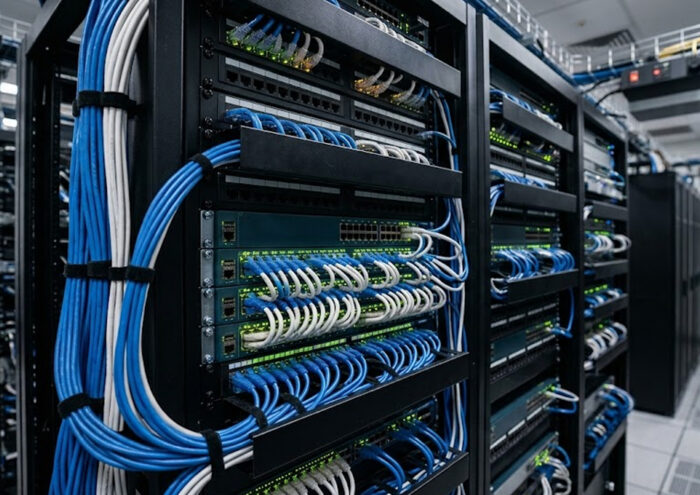
Structured Cabling is an organized system of cables, pathways, racks, patch panels, and connection points that supports data, voice, video, security, wireless, and communication systems throughout a building or campus.
Instead of relying on messy wiring or temporary fixes, structured cabling follows a planned design. Because of this, businesses gain better network organization, easier troubleshooting, stronger performance, and more flexibility as technology needs change.
A professional Structured Cabling system may include:
- Cat6 and Cat6A cabling
- Fiber optic cabling
- Network racks
- Patch panels
- Cable trays and pathways
- Data drops
- Wireless access point cabling
- Server room cabling
- Data center cabling
- Cable testing and certification
For Virginia businesses, this foundation helps keep people, systems, and devices connected throughout the workday.
Why Connectivity Matters for Virginia Businesses
Connectivity affects nearly every part of business operations. Employees need reliable access to email, cloud platforms, VoIP phones, shared files, video meetings, security systems, and business applications. Meanwhile, facility teams may depend on cameras, access control, wireless devices, digital signage, and building technology.
Without strong connectivity, businesses may experience:
- Slow network speeds
- Dropped connections
- Poor Wi-Fi performance
- Delayed cloud access
- Security camera interruptions
- Unreliable conference room systems
- Difficult troubleshooting
- Increased downtime
- Higher support costs
For example, a corporate office in Arlington may need dependable cloud access for hybrid employees. Meanwhile, a warehouse in Norfolk may rely on wireless scanners, inventory systems, and IP Security cameras. Similarly, a healthcare facility in Richmond may need stable connectivity for patient systems, staff devices, and secure communications.
In each case, Structured Cabling helps create a stronger and more dependable network environment.
Structured Cabling Improves Network Reliability
One of the biggest benefits of Structured Cabling is improved reliability. When cabling is poorly installed, outdated, damaged, or disorganized, businesses can experience recurring connectivity problems that are difficult to diagnose.
Professional Structured Cabling improves reliability by providing:
- Clean cable pathways
- Proper terminations
- Tested connections
- Organized patch panels
- Labeled cables
- Scalable network layouts
- Better documentation
As a result, devices stay connected more consistently, and IT teams can resolve issues faster. Additionally, organized cabling reduces the risk of accidental disconnections or confusion inside network closets.
For busy Virginia businesses, reliable connectivity means fewer interruptions and smoother daily operations.
Strong Cabling Supports Faster IT Infrastructure
Reliable IT Infrastructure depends on the physical systems that connect everything together. Servers, switches, routers, firewalls, wireless access points, phones, workstations, and cloud-connected tools all rely on cabling to communicate efficiently.
Structured Cabling supports IT Infrastructure by improving:
- Data transfer speed
- Network stability
- Cloud application access
- Workstation connectivity
- Wireless access point performance
- Server room organization
- Network scalability
Moreover, strong cabling helps businesses get better performance from their technology investments. Even advanced network equipment can underperform if the cabling behind it is not designed correctly.
This gives Virginia businesses a better foundation for long-term technology growth and operational success.
Better Structured Cabling Improves Wi-Fi Performance
Even wireless networks depend on physical cabling. Wireless access points must connect back to switches, routers, and firewalls through reliable network cabling. Therefore, poor cabling can weaken Wi-Fi performance, even when the wireless equipment itself is high quality.
Structured Cabling improves wireless connectivity by supporting:
- Better access point placement
- Stronger network backhaul
- Expanded coverage
- Higher device density
- More reliable roaming
- Future wireless upgrades
In larger Virginia offices, campuses, warehouses, and healthcare facilities, Radio Frequency planning may also be needed. Radio Frequency assessments help identify coverage gaps, reduce interference, and improve wireless performance across complex spaces.
When Structured Cabling and Radio Frequency planning work together, businesses gain stronger connectivity across both wired and wireless systems.
Structured Cabling Supports IP Security
Modern IP Security systems rely on dependable connectivity. Cameras, access control systems, intercoms, video management platforms, and monitoring tools all need stable network connections to work properly.
Structured Cabling supports IP Security by providing:
- Dedicated camera connections
- Power over Ethernet support
- Reliable access control connectivity
- Organized security pathways
- Easier troubleshooting
- Scalable camera expansion
- Better system uptime
For Virginia offices, warehouses, schools, healthcare facilities, commercial properties, and industrial sites, dependable IP Security is essential. If camera feeds drop or access control systems fail, safety and visibility can be affected.
Consequently, security systems should be included early in the cabling design process rather than added as an afterthought.
Structured Cabling Helps Managed Services Teams Work Faster
Many businesses rely on Managed Services to monitor systems, support users, manage cybersecurity, and maintain technology performance. However, managed IT providers can work more efficiently when the physical network is organized and documented.
Structured Cabling helps Managed Services teams:
- Diagnose issues faster
- Reduce recurring support calls
- Add users and devices efficiently
- Monitor network performance
- Maintain accurate documentation
- Plan upgrades with confidence
- Improve response times
In addition, clean cabling makes it easier to support growing businesses. When a company adds employees, expands departments, or upgrades equipment, organized infrastructure reduces disruption.
Structured Cabling Improves Data Center Connectivity
Businesses that depend on Data Centers need cabling systems designed for speed, uptime, airflow, and scalability. In data center environments, poor cable management can slow maintenance, restrict airflow, and increase the risk of downtime.
Professional Structured Cabling supports Data Centers through:
- Fiber optic backbone connections
- Copper network cabling
- Rack-to-rack connectivity
- Organized patch panels
- Clean cable pathways
- Better documentation
- Easier equipment upgrades
- Scalable expansion
For Virginia organizations handling sensitive data, financial systems, healthcare records, logistics platforms, or enterprise applications, data center connectivity is critical. Furthermore, clean cabling helps IT teams complete changes and repairs with less risk.
Structured Cabling Supports Audio Visual Services and Solutions
Modern workplaces depend on Audio Visual Services and Solutions for meetings, presentations, training, digital signage, and hybrid collaboration. These systems require dependable connectivity to perform well.
Structured Cabling can support:
- Conference room displays
- Video conferencing cameras
- Speakers and microphones
- Control systems
- Digital signage
- Video walls
- Wireless presentation tools
- Training room technology
When AV systems are supported by professional cabling, meetings run more smoothly, presentations are clearer, and teams communicate more effectively. As a result, employees spend less time troubleshooting and more time collaborating.
Structured Cabling Makes Growth Easier
As businesses grow, connectivity needs increase. A company may add employees, open new locations, expand office space, install more cameras, improve Wi-Fi, build conference rooms, or upgrade data center systems.
Structured Cabling supports growth by making it easier to add:
- Network drops
- Workstations
- Wireless access points
- Security cameras
- Access control systems
- Conference room technology
- Servers and storage
- New business applications
- Future Technologies
Additionally, scalable cabling helps businesses avoid costly rework. Instead of rebuilding the network every time new technology is added, companies can expand from a stronger foundation.
Electricity and Utility Construction Considerations
Structured Cabling projects often require coordination with power, pathways, conduit, grounding, equipment rooms, and site infrastructure. Therefore, Electricity/Utility Construction should be considered early in larger technology projects.
This is especially important for:
- New construction
- Office renovations
- Data center upgrades
- Outdoor security systems
- Wireless deployments
- Industrial facilities
- Multi-building campuses
- Network closet expansions
By coordinating cabling with electrical and utility needs early, Virginia businesses can avoid delays, reduce rework, and build stronger infrastructure from the beginning.
Why Virginia Businesses Choose Instrata
Instrata helps Virginia businesses design, install, and support reliable Structured Cabling and technology infrastructure. From Arlington and Alexandria to Richmond, Norfolk, Virginia Beach, Fairfax, Roanoke, Chesapeake, and surrounding communities, Instrata supports commercial, enterprise, industrial, and residential clients with scalable technology solutions.
Instrata specializes in:
- Structured Cabling
- IP Security
- Radio Frequency
- IT Infrastructure
- Electricity/Utility Construction
- Technologies
- Managed Services
- Data Centers
- Audio Visual Services and Solutions
By bringing these services together, Instrata helps organizations avoid the complexity of working with disconnected vendors. Instead, businesses can rely on one experienced partner for cabling, infrastructure, security, managed IT, data centers, RF planning, AV systems, and utility coordination.
Additionally, Instrata serves clients across Arizona, North Carolina, South Carolina, New Jersey, New York, Pennsylvania, and Maryland, making it a strong choice for regional and multi-location organizations.
Improve Connectivity with Instrata
Structured Cabling improves connectivity by creating a reliable, organized, and scalable foundation for modern business technology. It supports stronger IT Infrastructure, better wireless performance, dependable IP Security, efficient Managed Services, reliable Data Centers, Radio Frequency systems, and Audio Visual Services and Solutions.
For Virginia businesses that depend on fast, stable, and secure connections every day, professional cabling is one of the smartest investments for long-term performance.
Contact us today to learn how structured cabling can transform your business operations