

For businesses across Arizona, network reliability is essential to productivity, communication, security, and customer service. Whether your organization operates in Phoenix, Scottsdale, Tucson, Mesa, Tempe, Chandler, Flagstaff, or a growing industrial corridor, even a short network failure can interrupt daily operations and create unnecessary costs.
That is why Structured Cabling plays such an important role in preventing network problems. A professionally designed cabling system gives businesses a clean, organized, and scalable foundation for IT Infrastructure, IP Security, Radio Frequency, Managed Services, Data Centers, Electricity/Utility Construction, modern Technologies, and Audio Visual Services and Solutions.
Instrata helps commercial, enterprise, industrial, and residential clients across Arizona build reliable technology environments designed to reduce downtime, improve performance, and support long-term growth.
Why Network Failures Happen
Network failures can happen for many reasons. Sometimes equipment is outdated, while other times poor cabling creates hidden problems that affect the entire system. In many cases, businesses do not realize that disorganized or aging cables are the source of recurring connectivity issues.
Common causes of network failures include:
- Poor cable installation
- Damaged or aging cables
- Unlabeled connections
- Overloaded pathways
- Loose terminations
- Inadequate cable testing
- Poor rack and patch panel organization
- Weak planning for future technology growth
As a result, employees may experience slow applications, dropped video calls, unreliable wireless access, disconnected security cameras, or repeated outages.
How Structured Cabling Reduces Network Risk
Structured Cabling helps prevent failures by creating an organized system for data, voice, video, wireless access points, security devices, AV equipment, and connected business systems. Instead of relying on random cable runs or temporary fixes, businesses gain a documented infrastructure that is easier to manage.
Additionally, professional cabling reduces the chance of connection errors, cable damage, and troubleshooting delays. This is especially important for Arizona businesses that depend on cloud platforms, remote teams, warehouse systems, customer-facing applications, and real-time communication.
Structured Cabling helps avoid network failures by:
- Improving connection stability
- Reducing signal interference
- Supporting faster troubleshooting
- Organizing network pathways
- Supporting future equipment upgrades
- Reducing cable clutter in telecom rooms
- Improving performance for IP Security and AV systems
- Creating a scalable foundation for modern Technologies
Consequently, businesses can improve uptime and reduce the risk of preventable technology disruptions.
Professional Cabling Supports Stronger IT Infrastructure
A reliable IT Infrastructure depends on more than routers, switches, and servers. It also depends on the physical connections that allow those systems to communicate.
If cabling is poorly installed or undocumented, IT teams may spend hours trying to locate the source of a problem. However, when cabling is labeled, tested, and organized, troubleshooting becomes much faster.
For example, a Scottsdale office may need structured cabling to support workstations, conference rooms, and cloud applications. Meanwhile, a Phoenix warehouse may rely on cabling for scanners, cameras, access points, and inventory platforms. Similarly, a healthcare facility in Tucson may need dependable connectivity for secure communication and patient-facing systems.
Because each environment has different technology needs, professional planning is essential.
Structured Cabling Helps IP Security Stay Online
Modern IP Security systems depend on reliable network connections. Surveillance cameras, access control systems, intercoms, video management platforms, and monitoring tools all need stable cabling to perform properly.
When cabling is weak or disorganized, cameras may drop offline, video feeds may lag, and access control systems may become inconsistent. Therefore, structured cabling is a critical part of security system reliability.
Strong cabling supports IP Security by helping businesses:
- Maintain stable camera connections
- Improve video transmission quality
- Support access control devices
- Reduce security system downtime
- Organize security network pathways
- Prepare for future camera expansion
For Arizona offices, schools, healthcare facilities, industrial sites, and commercial properties, reliable IP Security can help protect people, property, and operations.
Data Centers Need Organized Cabling
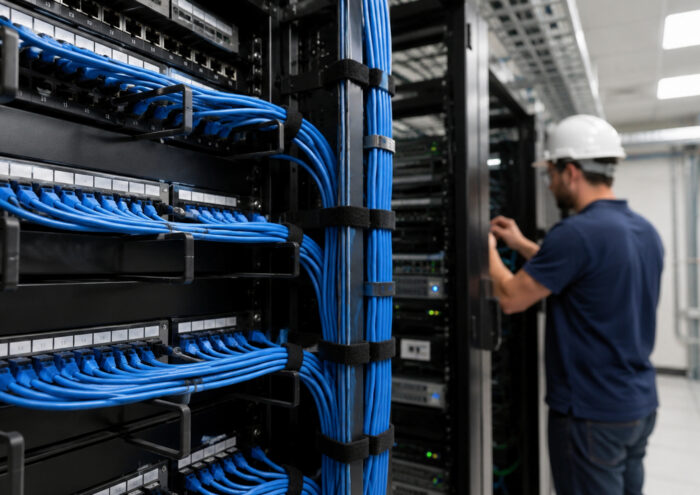
Data Centers and server rooms are especially vulnerable to problems caused by poor cabling. Disorganized cables can restrict airflow, create maintenance delays, increase human error, and make equipment upgrades more difficult.
In contrast, professional Structured Cabling keeps racks, patch panels, pathways, and connections clean and manageable. Moreover, organized cabling helps IT teams identify issues quickly and reduce the risk of accidental disconnections.
Data center cabling best practices include:
- Clear labeling and documentation
- Organized rack layouts
- Proper cable management
- Tested and certified connections
- Scalable pathways for future equipment
- Coordination with power and cooling requirements
For Arizona businesses in finance, healthcare, logistics, education, manufacturing, and professional services, reliable Data Centers are essential to business continuity.
Radio Frequency Systems Depend on Wired Support
Although Radio Frequency solutions support wireless connectivity, wireless systems still depend on strong wired infrastructure. Access points, switches, controllers, and network equipment all require reliable cabling.
If the cabling behind wireless access points is outdated or poorly installed, users may experience weak signals, dropped connections, or slow wireless speeds. Therefore, Structured Cabling and Radio Frequency planning should work together.
For instance, a resort in Scottsdale may need strong wireless coverage for guests, staff, and security systems. Additionally, a distribution center in Mesa may need dependable RF performance for scanners and mobile workflows. Likewise, a corporate office in Tempe may need reliable wireless access for hybrid meetings and collaboration tools.
Managed Services Help Maintain Network Reliability
Installing Structured Cabling is only one part of avoiding network failures. Over time, businesses add devices, update systems, renovate spaces, and expand operations. As a result, network needs continue to change.
Managed Services help organizations monitor, maintain, and optimize their technology environments after installation. This support may include network monitoring, troubleshooting, security updates, backup planning, vendor coordination, and hardware lifecycle management.
With proactive support, businesses can identify small issues before they become major failures. In addition, IT teams can focus more on strategy and less on emergency repairs.
Electricity/Utility Construction Supports Reliable Deployments
Modern technology systems require proper power, pathways, low-voltage infrastructure, and utility coordination. Electricity/Utility Construction plays an important role during new construction, renovations, data center upgrades, office expansions, and security deployments.
When power, cabling, and technology infrastructure are planned together, businesses can reduce delays, avoid costly rework, and create cleaner technology environments. As a result, systems are more reliable from the beginning.
Audio Visual Services and Solutions Need Stable Networks
Meeting rooms, training spaces, digital signage, command centers, and hybrid collaboration environments rely on strong network connectivity. Audio Visual Services and Solutions often require cabling for displays, microphones, speakers, cameras, control systems, and network-connected AV devices.
When cabling is unreliable, presentations may freeze, video calls may lag, and audio may become inconsistent. However, professional Structured Cabling helps AV systems perform more smoothly and supports better communication across teams.
Why Arizona Businesses Choose Instrata
Instrata serves clients throughout Arizona, as well as North Carolina, South Carolina, New Jersey, New York, Pennsylvania, Maryland, and Virginia. Businesses choose Instrata because they need a technology partner that understands every layer of modern infrastructure.
From Structured Cabling and IP Security to Radio Frequency, IT Infrastructure, Managed Services, Data Centers, Electricity/Utility Construction, Technologies, and Audio Visual Services and Solutions, Instrata delivers comprehensive support for commercial, enterprise, industrial, and residential clients.
Whether your organization is upgrading an office in Phoenix, modernizing a facility in Scottsdale, improving wireless systems in Tucson, or supporting a data center in Chandler, Instrata provides fast, professional, and reliable technology solutions.
Prevent Network Failures With Structured Cabling
Structured Cabling helps avoid network failures by improving connection stability, reducing cable-related issues, supporting faster troubleshooting, and creating a scalable foundation for business technology.
Contact us today to learn how structured cabling can transform your business operations