

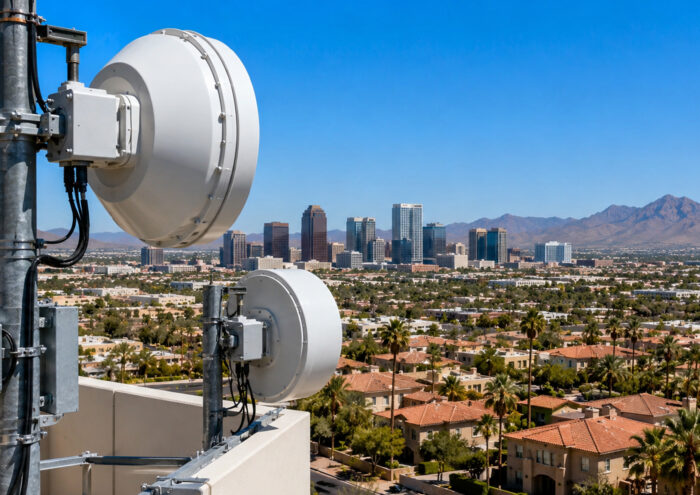
Modern businesses across Arizona rely on fast, stable, and secure networking to keep operations running smoothly. From offices in Phoenix and Scottsdale to warehouses in Mesa, manufacturing facilities in Tucson, healthcare organizations in Chandler, and commercial properties in Tempe, reliable connectivity is no longer optional. It is essential.
While many companies think of networking in terms of switches, routers, servers, and cables, Radio Frequency plays a major role in today’s connected environments. Wireless devices, access points, mobile scanners, security systems, communication tools, and cloud-connected platforms all depend on strong RF design.
For Arizona businesses, Radio Frequency supports modern networking by improving wireless coverage, reducing interference, enabling mobility, and strengthening overall IT Infrastructure. When combined with professional Structured Cabling, Managed Services, IP Security, Data Centers, and Audio Visual Services and Solutions, RF becomes a critical part of a scalable technology strategy.
What Is Radio Frequency in Networking?
Radio Frequency, often called RF, refers to the wireless signals used to transmit data between devices. These signals allow laptops, tablets, phones, scanners, access points, sensors, cameras, and communication systems to connect without direct physical cabling.
In modern business environments, Radio Frequency can support:
- Wi-Fi networks
- Wireless access points
- Barcode scanners
- Mobile workstations
- Inventory tracking systems
- IoT devices
- Wireless cameras
- Point-of-sale systems
- Campus communication tools
- Industrial monitoring systems
Although RF is wireless, it still depends on a well-planned network foundation. Access points, controllers, switches, firewalls, and cabling all work together to support strong wireless performance.
Because of this, Radio Frequency should be planned as part of the larger IT Infrastructure rather than treated as a separate technology.
Why Arizona Businesses Need Reliable RF Design
Arizona businesses operate in many different environments. A corporate office in Scottsdale may need dependable Wi-Fi for hybrid meetings and cloud applications. Meanwhile, a warehouse in Mesa may rely on RF-connected scanners for inventory management. Similarly, a healthcare facility in Phoenix may need secure mobile access for staff and connected medical systems.
Without proper RF planning, businesses may experience:
- Wireless dead zones
- Dropped device connections
- Slow cloud application access
- Interference from walls, equipment, or other networks
- Poor coverage in large spaces
- Unreliable mobile device performance
- Security camera disruptions
- Increased IT support requests
These problems can reduce productivity and create frustration for employees, customers, and facility teams. Therefore, professional RF design is essential for businesses that depend on wireless technology throughout the day.
Radio Frequency Improves Wireless Coverage
One of the biggest benefits of Radio Frequency planning is improved wireless coverage. Many businesses assume that adding more access points will solve connection problems. However, too many access points in the wrong locations can create signal overlap, interference, and inconsistent performance.
A professional RF assessment helps determine where access points should be placed based on building layout, device usage, user density, construction materials, and business operations.
Better wireless coverage supports:
- Office productivity
- Warehouse mobility
- Guest networks
- Cloud applications
- Video conferencing
- Mobile devices
- Security systems
- Industrial technology
For example, a distribution center in Tucson may need coverage across loading docks, storage aisles, and outdoor areas. At the same time, a business office in Phoenix may need strong coverage in conference rooms, open workspaces, and executive areas.
With proper RF planning, devices stay connected more consistently as users move throughout the facility.
RF Reduces Interference and Network Disruptions
Wireless signals can be affected by many physical and environmental factors. In Arizona commercial and industrial spaces, interference may come from metal shelving, concrete walls, machinery, electrical systems, neighboring networks, elevators, and high-density device usage.
As a result, businesses may experience unstable connections even when they have newer wireless equipment.
Radio Frequency planning helps reduce interference through:
- Signal testing
- Channel planning
- Access point placement
- Antenna selection
- Power level adjustments
- Coverage mapping
- Device density planning
- Ongoing performance reviews
By reducing interference, businesses can improve network reliability and create a better experience for employees and customers.
Structured Cabling Supports RF Performance
Even though Radio Frequency enables wireless communication, the wireless network still relies on physical infrastructure. Access points need strong connections back to the network, and those connections depend on professional Structured Cabling.
Structured Cabling supports RF systems by providing:
- Reliable access point connections
- Clean cable pathways
- Organized network closets
- Fiber and copper backbone support
- Proper patch panel layouts
- Easier troubleshooting
- Scalable expansion options
Without strong cabling, wireless systems may suffer from bottlenecks, unstable access points, or difficult maintenance. In contrast, professionally installed cabling gives Arizona businesses a cleaner, more reliable foundation for wireless networking.
Additionally, Structured Cabling helps companies prepare for future upgrades, including additional access points, higher bandwidth requirements, and expanded device networks.
RF Strengthens Modern IT Infrastructure
Reliable IT Infrastructure must support both wired and wireless systems. Today’s businesses use cloud platforms, mobile devices, collaboration tools, security systems, and connected equipment that all depend on stable networking.
Radio Frequency strengthens IT Infrastructure by supporting:
- Wireless device connectivity
- Secure employee access
- Mobile workflows
- Real-time communication
- Cloud application performance
- Operational visibility
- Scalable network expansion
For Arizona companies with growing teams or multiple locations, RF planning also helps standardize the wireless experience. Consequently, employees can work more efficiently whether they are in an office, warehouse, healthcare facility, or industrial site.
A strong RF strategy also gives businesses greater precision when planning technology upgrades, because network performance is based on real coverage needs rather than guesswork.
Radio Frequency Supports IP Security
Modern IP Security systems often depend on network connectivity. While many cameras and access control systems are wired, some environments require wireless links, mobile monitoring tools, or RF-supported communication.
Radio Frequency can support IP Security for:
- Outdoor camera locations
- Parking lots
- Gates and perimeter areas
- Warehouses
- Multi-building campuses
- Temporary monitoring points
- Mobile security devices
- Remote facility areas
For Arizona businesses with large properties, outdoor yards, logistics operations, or industrial facilities, RF planning can help extend security coverage where traditional cabling may be difficult.
However, IP Security should still be planned carefully with network capacity, cybersecurity, power, cabling, and monitoring in mind. When these systems work together, businesses gain stronger protection and better visibility.
Managed Services Keep RF Networks Performing
Wireless networks need ongoing care. Device updates, access point performance, security settings, user growth, and changing facility layouts can all affect RF reliability over time.
That is why Managed Services are valuable for RF-supported environments.
Managed Services can help with:
- Network monitoring
- Wireless performance reviews
- Access point management
- Security updates
- User support
- Device troubleshooting
- Cloud connectivity support
- Infrastructure documentation
- Upgrade planning
For busy IT managers and facility teams, managed support reduces the pressure of maintaining every system internally. Moreover, proactive monitoring helps identify problems before they disrupt operations.
RF and Data Centers in Modern Networking
Although Data Centers rely heavily on wired infrastructure, Radio Frequency can still support important operational needs. Secure wireless access, mobile maintenance tools, asset tracking, facility monitoring, and security communication may all depend on RF performance.
In data center and server room environments, reliability is especially important. Poor wireless planning can affect maintenance workflows, monitoring access, and response times.
When RF is integrated with Data Centers, Structured Cabling, IP Security, and Managed Services, businesses create a more complete networking environment that supports uptime and operational efficiency.
Electricity and Utility Construction Considerations
Radio Frequency systems often require proper power, mounting locations, pathways, grounding, conduit, rooftop access, poles, and equipment spaces. Therefore, Electricity/Utility Construction should be considered early in RF planning.
This is especially important for:
- Outdoor wireless systems
- Campus networks
- Industrial sites
- Utility locations
- Security deployments
- Data center facilities
- Warehouses
- New construction projects
By coordinating RF design with power and utility needs, Arizona businesses can reduce installation delays, avoid rework, and ensure systems are built on the right physical foundation.
RF Supports Audio Visual Services and Solutions
Modern Audio Visual Services and Solutions often rely on both wired and wireless connectivity. Conference rooms, training spaces, digital signage, wireless presentation systems, and hybrid meeting tools all need reliable network performance.
Radio Frequency planning can improve AV performance by supporting:
- Wireless presentation tools
- Video conferencing devices
- Mobile control systems
- Digital signage updates
- Training room technology
- Conference room connectivity
- Hybrid collaboration systems
For Arizona offices and enterprise spaces, strong RF design helps meetings run more smoothly and reduces communication disruptions.
Why Arizona Businesses Choose Instrata
Instrata helps Arizona businesses design, deploy, and support reliable technology environments built for performance, security, and growth. From Phoenix and Scottsdale to Tucson, Mesa, Chandler, Tempe, Glendale, and surrounding communities, Instrata supports commercial, enterprise, industrial, and residential clients with professional technology solutions.
Instrata specializes in:
- Structured Cabling
- IP Security
- Radio Frequency
- IT Infrastructure
- Electricity/Utility Construction
- Technologies
- Managed Services
- Data Centers
- Audio Visual Services and Solutions
By bringing these services together, Instrata helps organizations avoid the complexity of managing multiple disconnected vendors. Instead, businesses can rely on one experienced partner for RF planning, cabling, infrastructure, security, AV systems, managed IT, data centers, and utility coordination.
Instrata also serves clients across North Carolina, South Carolina, New Jersey, New York, Pennsylvania, Maryland, and Virginia, making it a strong choice for regional and multi-location organizations.
Build a Stronger Network with Instrata
Radio Frequency supports modern networking by improving wireless coverage, reducing interference, enabling mobile workflows, strengthening IP Security, and enhancing overall IT Infrastructure. For Arizona businesses that depend on cloud platforms, mobile devices, warehouse systems, data centers, AV tools, and connected Technologies, RF planning is essential.
Contact us today to learn how structured cabling can transform your business operations