

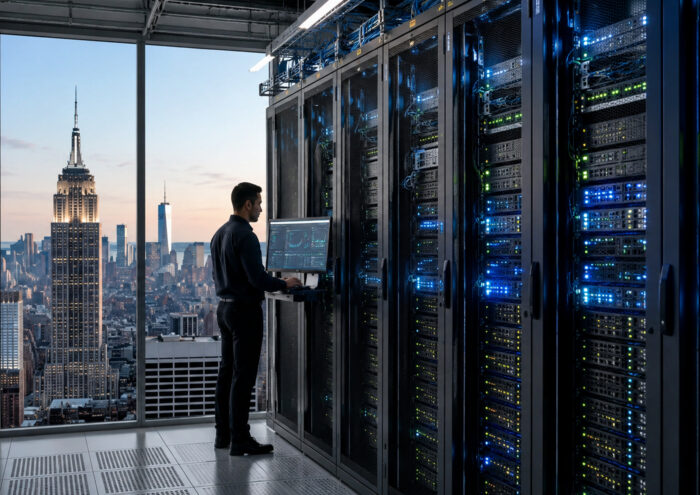
For businesses in New York, downtime is more than an inconvenience. It can disrupt customer service, delay transactions, interrupt employee productivity, compromise security, and affect revenue. Whether your organization operates in Manhattan, Brooklyn, Queens, Long Island, Westchester, Albany, Buffalo, Rochester, or another growing commercial corridor across the state, reliable technology is essential to daily operations.
Because of this, Data Centers play a major role in business uptime. A well-designed data center environment supports critical applications, cloud access, secure storage, network performance, backup systems, and disaster recovery. Moreover, when combined with professional IT Infrastructure, Structured Cabling, IP Security, Managed Services, and other modern Technologies, data centers help businesses stay connected, protected, and operational.
Why Business Uptime Matters in New York
New York businesses operate in fast-moving, competitive environments. Financial firms, healthcare providers, law offices, retailers, logistics companies, educational institutions, media organizations, and enterprise teams all depend on technology to serve clients and manage operations.
Even a short outage can create serious problems, such as:
- Lost productivity
- Missed customer requests
- Interrupted payment systems
- Delayed communications
- Security vulnerabilities
- Data access issues
- Compliance concerns
- Damage to customer trust
As a result, uptime is directly tied to business performance for companies that rely on cloud platforms, databases, security systems, communication tools, or high-volume transactions.
Data Centers help reduce downtime by creating controlled, secure, and scalable environments for mission-critical systems.
What Do Data Centers Do?
Data Centers house and support the technology systems businesses rely on every day. These environments may include servers, storage systems, networking equipment, backup solutions, firewalls, monitoring tools, and cloud-connected infrastructure.
A professional data center environment is designed to support:
- Application availability
- Secure data storage
- Network connectivity
- Backup and disaster recovery
- Cloud and hybrid environments
- Server performance
- Redundant systems
- Physical and digital security
- Business continuity
For New York businesses, this means critical systems are supported by infrastructure designed for reliability rather than improvised server rooms or outdated equipment closets. In addition, a professional data center gives organizations a stronger foundation for future growth.
Redundancy: The Foundation of Uptime
One of the most important ways Data Centers support uptime is through redundancy. In simple terms, redundancy means critical systems have backup components in place so operations can continue if one part fails.
This may include:
- Redundant power systems
- Backup internet connections
- Multiple network paths
- Duplicate servers
- Failover systems
- Backup storage
- Cooling redundancy
- Disaster recovery platforms
For example, a financial services firm in Manhattan may need uninterrupted access to trading platforms and client data. Meanwhile, a healthcare organization in Queens may require reliable access to patient systems. Similarly, a logistics company on Long Island may need inventory and routing platforms online throughout the day.
With redundant design in place, businesses are better prepared for unexpected disruptions.
Strong IT Infrastructure Keeps Systems Connected
Data center uptime depends on strong IT Infrastructure. Servers and storage systems are only part of the equation. The network, firewalls, switches, routers, wireless systems, endpoints, and cloud connections also need to work together.
Reliable IT Infrastructure supports:
- Faster application performance
- Secure remote access
- Stable cloud connectivity
- Better user experiences
- Reduced network bottlenecks
- Improved system monitoring
- Easier troubleshooting
- Scalable growth
For a New York office with hybrid employees, IT Infrastructure may support secure access to cloud applications. In a Buffalo warehouse, it may support inventory platforms and wireless scanning. For a media company in Brooklyn, it may enable large file transfers and real-time collaboration tools.
Ultimately, the stronger the infrastructure, the more dependable the business operation becomes.
Why Structured Cabling Matters in Data Centers
Behind every reliable data center is organized and professional Structured Cabling. Poor cabling can cause slow connections, hard-to-trace outages, airflow problems, and unnecessary downtime.
Professional Structured Cabling helps data centers by supporting:
- High-speed fiber and copper connections
- Rack-to-rack connectivity
- Clean cable management
- Easier maintenance
- Faster troubleshooting
- Better airflow
- Scalable expansion
- Network documentation
In New York, where space can be limited and business demands are high, clean cabling design is especially valuable. Whether supporting a server room in Manhattan, a corporate office in Westchester, or an enterprise facility in Albany, structured cabling helps keep systems organized and reliable.
Furthermore, a well-planned cabling system improves operational resilience by reducing weak points in the technology environment.
IP Security Protects Critical Systems
Uptime is not only about keeping systems powered and connected. It is also about protecting them. Therefore, IP Security plays a critical role in safeguarding data centers, server rooms, network closets, and business facilities.
IP Security systems may include:
- Network-connected cameras
- Access control systems
- Video monitoring
- Door entry management
- Remote security visibility
- Motion detection
- Visitor tracking
- Security alerts
For New York businesses handling sensitive data, financial records, healthcare information, legal documents, or enterprise applications, physical security is essential.
Only authorized personnel should access data center spaces. With IP Security, businesses can monitor activity, control access, and protect critical equipment from unauthorized entry or tampering.
Managed Services Help Prevent Downtime
Even the best data center environment requires ongoing management. Systems need monitoring, updates, security checks, maintenance, documentation, and support. For that reason, Managed Services are valuable for organizations that want to prevent downtime before it happens.
Managed Services help businesses improve uptime by providing:
- Proactive monitoring
- Server maintenance
- Network support
- Cybersecurity management
- Backup verification
- Patch management
- Help desk support
- Vendor coordination
- Performance reporting
- Disaster recovery planning
For busy IT managers and business leaders, Managed Services reduce the pressure of managing every system internally. Instead of waiting for equipment to fail or users to report problems, managed support helps identify and address issues early.
Consequently, New York companies can avoid unnecessary downtime and maintain smoother operations.
Data Centers Support Cloud and Hybrid Technologies
Many businesses now use a mix of on-premise systems, private cloud platforms, public cloud services, and remote work tools. Data Centers support these hybrid Technologies by connecting business systems securely and reliably.
A strong data center strategy can support:
- Cloud application access
- Hybrid work environments
- Remote employees
- Secure file storage
- Virtual servers
- Backup platforms
- Collaboration tools
- Business applications
- Secure network connections
For a New York company with teams working across offices, homes, and client sites, data centers help maintain access to the systems people need to stay productive. Additionally, hybrid infrastructure gives businesses more flexibility as technology needs evolve.
Radio Frequency and Wireless Reliability
Although Data Centers often focus on wired systems, Radio Frequency can also support business uptime in facilities that depend on wireless communication and mobile devices.
Radio Frequency planning is especially valuable for:
- Warehouses
- Distribution centers
- Healthcare facilities
- Campuses
- Manufacturing sites
- Large commercial properties
- Utility environments
RF solutions can support mobile workstations, barcode scanners, asset tracking, wireless security tools, and operational communication. When RF design is integrated with IT Infrastructure and data center planning, businesses gain more reliable connectivity across the entire facility.
Electricity and Utility Construction for Data Center Reliability
Data centers depend heavily on proper power and utility planning. Therefore, Electricity/Utility Construction supports the physical foundation needed to keep systems running.
This may involve:
- Power pathways
- Conduit planning
- Grounding
- Utility coordination
- Equipment room preparation
- Backup power planning
- Site infrastructure
- Outdoor technology support
For New York businesses expanding offices, upgrading network rooms, building data centers, or deploying new technology systems, electricity and utility planning should happen early. Proper coordination helps reduce installation delays, avoid rework, and support long-term uptime.
Audio Visual Services and Solutions Depend on Uptime
Modern workplaces rely on Audio Visual Services and Solutions for meetings, presentations, training, digital signage, and hybrid collaboration. These systems often depend on the same network and infrastructure supported by the data center.
Reliable data center and IT infrastructure support helps AV systems perform better by improving:
- Video conferencing stability
- Digital signage updates
- Conference room connectivity
- Presentation systems
- Training room technology
- Remote collaboration
- Control system reliability
As a result, New York offices and enterprise environments can communicate more clearly and avoid productivity delays.
Why New York Businesses Choose Instrata
Instrata helps New York businesses build reliable, secure, and scalable technology environments designed to support uptime and long-term growth. From Manhattan, Brooklyn, Queens, and Long Island to Westchester, Albany, Buffalo, Rochester, and surrounding communities, Instrata supports commercial, enterprise, industrial, and residential clients with professional technology solutions.
Instrata specializes in:
- Structured Cabling
- IP Security
- Radio Frequency
- IT Infrastructure
- Electricity/Utility Construction
- Technologies
- Managed Services
- Data Centers
- Audio Visual Services and Solutions
By bringing these services together, Instrata helps organizations avoid the complexity of working with multiple disconnected vendors. Instead, businesses can rely on one experienced partner for data centers, cabling, infrastructure, security, managed IT, AV systems, RF planning, and utility coordination.
Instrata also serves clients across Arizona, North Carolina, South Carolina, New Jersey, Pennsylvania, Maryland, and Virginia. This regional reach makes Instrata a strong choice for businesses with multi-location technology needs.
Keep Your Business Running with Instrata
Data Centers are critical to business uptime in New York. They help protect applications, support cloud connectivity, improve security, enable disaster recovery, and keep mission-critical systems available.
When supported by professional Structured Cabling, IP Security, Radio Frequency planning, IT Infrastructure, Electricity/Utility Construction, Managed Services, Technologies, and Audio Visual Services and Solutions, data centers become a powerful foundation for business continuity.