

For businesses across California, reliable voice and data cabling is essential to daily performance. Whether supporting phones, internet access, cloud platforms, wireless networks, security systems, or conference room technology, the quality of your cabling infrastructure has a direct impact on productivity. Yet many organizations still underestimate how much poorly planned cabling can affect operations.
From office buildouts in Los Angeles to warehouses in Riverside, healthcare facilities in San Diego, and corporate spaces in San Jose, businesses often make avoidable cabling mistakes that lead to downtime, slower network performance, rising maintenance costs, and limited scalability. Understanding these issues early can help organizations protect their investments and build stronger, more efficient systems.
Why Voice and Data Cabling Matters
Voice and data cabling is the physical backbone of modern business communication. It supports phone systems, internet connectivity, internal networks, wireless access points, collaboration tools, and a wide range of connected technologies. In many cases, it also works alongside Structured Cabling, IP Security, Audio Visual Services and Solutions, and broader IT Infrastructure deployments.
When voice and data cabling is done correctly, businesses gain:
- More reliable network performance
- Easier troubleshooting and maintenance
- Better support for future growth
- Stronger uptime and operational continuity
When it is done poorly, even the best hardware and software can underperform.
The Most Common Cabling Mistakes Businesses Make
Many problems do not come from the technology itself. They come from poor planning, rushed installations, or short-term decisions that create long-term complications.
1. Treating Cabling as an Afterthought
One of the most common mistakes businesses make in California is waiting too long to think about cabling. Voice and data wiring is often pushed to the end of a project, after layout, electrical work, and equipment decisions have already been made.
This can create serious issues, including:
- Poor cable routing
- Inconvenient outlet and port placement
- Inadequate capacity for devices and users
- Higher change-order costs during construction
Cabling should be part of the early design conversation, especially in new offices, tenant improvements, industrial facilities, and commercial renovations.
2. Choosing the Cheapest Installation Instead of the Right One
Budget matters, but low-cost cabling work often becomes expensive over time. Some businesses hire installers based only on price, without evaluating standards, testing procedures, labeling practices, or future-readiness.
The result may include:
- Inconsistent performance
- Unlabeled or poorly terminated cables
- More troubleshooting calls
- Expensive rework during upgrades
Professional Structured Cabling is designed for long-term reliability. Cutting corners may save money upfront, but it can create recurring costs that disrupt business operations later.
3. Failing to Plan for Growth
Many California businesses install just enough cabling for current needs without thinking about expansion. This is especially risky in fast-growing sectors such as logistics, healthcare, education, technology, and professional services.
A network that works today may struggle tomorrow if the business adds:
- More employees
- Additional workstations
- Security cameras
- Wireless access points
- New meeting room technology
- Connected devices and smart building systems
Scalable cabling supports both current performance and future flexibility. It also makes it easier to integrate Managed Services, updated Technologies, and new business applications without major disruption.
Mistakes That Hurt Daily Operations
Some cabling issues are not obvious during installation. They become visible later through slow speeds, outages, and operational inefficiencies.
4. Poor Labeling and Documentation
Unlabeled cables are one of the biggest headaches in any business environment. When ports, patch panels, and cable runs are not documented properly, simple maintenance becomes time-consuming and frustrating.
Poor labeling can lead to:
- Longer service calls
- Increased downtime
- Confusion during moves, adds, and changes
- Greater risk of disconnecting the wrong systems
Good documentation is not a luxury. It is a practical requirement for efficient IT Infrastructure management.
5. Ignoring Cable Management
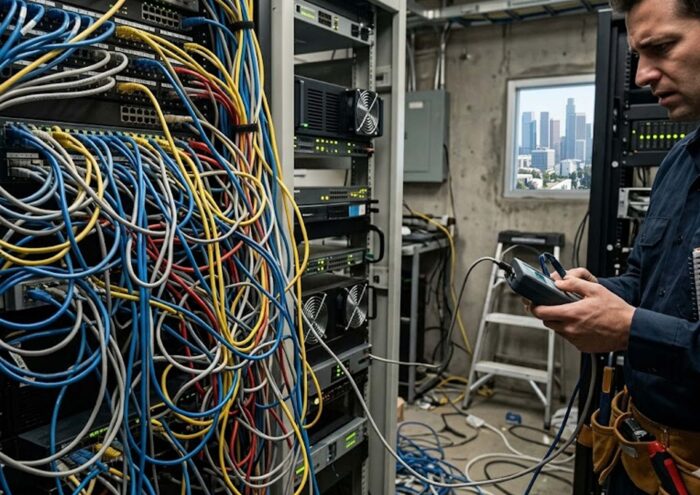
Messy cable bundles may seem harmless, but they often lead to avoidable problems. Disorganized cabling makes it harder to trace issues, upgrade equipment, or maintain clean equipment rooms.
Strong cable management improves:
- Airflow in network closets and Data Centers
- Serviceability and maintenance access
- Visual organization and professionalism
- Long-term system reliability
For businesses operating in high-demand environments, organized infrastructure supports better uptime and lower support costs.
6. Mixing Old and New Cabling Without a Strategy
Another common mistake is layering new systems onto outdated cabling without evaluating whether the existing infrastructure can still meet performance demands. Businesses may upgrade phones, switches, access points, or cloud systems while leaving behind cabling that no longer supports the required speeds or standards.
This can create bottlenecks that affect:
- Voice clarity
- Data transfer speeds
- Video conferencing performance
- Device reliability
- Network consistency across the workplace
Before expanding or modernizing, businesses should assess whether their current cabling is still aligned with operational needs.
Overlooking Integration with Other Systems
Voice and data cabling does not exist in isolation. It often supports or intersects with multiple business-critical technologies.
7. Not Coordinating with Security, AV, and Wireless Systems
Businesses sometimes plan network cabling separately from IP Security, conference room technology, and wireless infrastructure. That siloed approach can lead to incomplete coverage, poor equipment placement, or rework after installation.
Integrated planning helps support:
- Security camera connectivity
- Access control systems
- Wireless access point placement
- Audio Visual Services and Solutions in conference rooms
- Better overall user experience
In larger facilities, coordination may also be important for Radio Frequency applications, especially in warehouses, industrial sites, healthcare environments, and campuses where communications and coverage need to be reliable.
8. Overlooking Environmental and Facility Conditions
California businesses operate in a wide variety of environments, from corporate offices and retail stores to manufacturing sites and distribution centers. Each setting has unique demands. Cabling that works well in a standard office may not be appropriate in a harsher or more complex environment.
Factors that should be considered include:
- Heat and ventilation in telecom rooms
- Distance limitations for cable runs
- Pathway congestion
- Expansion needs for multi-tenant facilities
- Coordination with Electricity/Utility Construction during larger site upgrades
Ignoring these conditions can lead to performance issues, safety concerns, and avoidable installation complications.
Why Professional Cabling Design Matters
Professional cabling design helps businesses avoid reactive fixes and build a stronger technology foundation from the start. A well-executed installation supports not only voice and data, but also the systems that depend on them every day.
The advantages of professional planning include:
- Better network reliability
- Easier maintenance and troubleshooting
- Cleaner integration with security and AV systems
- Stronger support for cloud, communications, and business applications
- Improved readiness for future growth
For organizations relying on modern communication platforms, connected offices, and secure networks, professional cabling is a business decision, not just a construction detail.
How Instrata Supports Smarter Infrastructure Decisions
Businesses need more than a basic installer. They need a technology partner that understands how cabling, connectivity, and operational performance work together. Instrata delivers expert support in Structured Cabling, IP Security, Radio Frequency, IT Infrastructure, Electricity/Utility Construction, Managed Services, Data Centers, and Audio Visual Services and Solutions.
With experience supporting commercial, enterprise, and industrial environments, Instrata helps organizations avoid common infrastructure mistakes and implement technology systems that are reliable, scalable, and built for performance.
Build a Better Foundation for Business Growth
Voice and data cabling mistakes can quietly undermine productivity, create unnecessary downtime, and increase costs over time. The good news is that most of these problems are preventable with the right planning, installation standards, and long-term strategy.
For businesses in California, investing in properly designed cabling infrastructure means stronger network performance, smoother communication, easier upgrades, and more dependable daily operations.
Contact us today to learn how structured cabling can transform your business operations